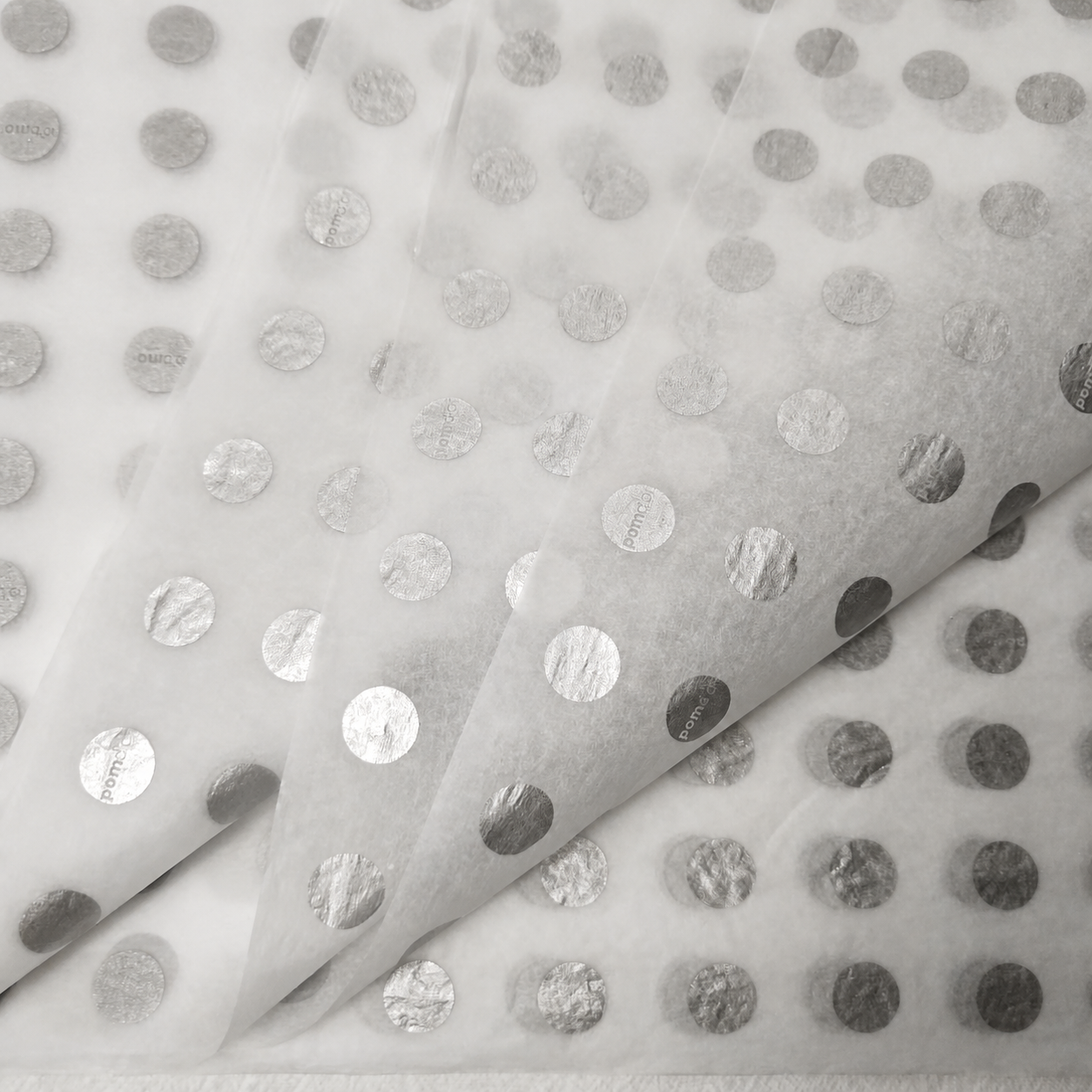
Metallic silver printing can look very different depending on the paper underneath it. Paper absorbency, surface characteristics, ink deposit, and printing method all influence whether the finished result appears dull, glossy, or genuinely metallic.
In this project, a customer requested 80 gsm white kraft paper printed with a silver pattern. The heavier paper was intentional because the customer wanted tissue paper with a more substantial feel and lower transparency.
Knowing that white kraft paper can absorb ink and potentially reduce the visual impact of metallic silver, we evaluated both offset and screen-printed silver during trial production. Screen printing produced a brighter, glossier result than offset printing, but the effect was primarily reflective rather than distinctly metallic.
After evaluating the results, we explored a less conventional solution: 80 gsm machine-glazed (MG) paper with flexographic silver printing. This allowed us to retain the heavier paper weight while achieving the metallic silver appearance the customer wanted.
Quick Answer: The customer requested 80 gsm white kraft paper with silver printing because they wanted relatively thick, less transparent tissue paper. Knowing that the absorbent kraft surface could affect the silver appearance, we compared offset and screen printing during trial production. Screen printing was brighter and glossier, but the effect was mainly reflective rather than distinctly metallic. We therefore optimized the specification to 80 gsm machine-glazed paper with flexographic silver printing, achieving both the required paper weight and the desired metallic silver effect.
Case Study at a Glance
| Item | Project Details |
|---|---|
| Product | Custom printed tissue paper |
| Original Specification | 80 gsm white kraft paper with silver printing |
| Customer Priority | Relatively thick, less transparent paper with a metallic silver pattern |
| Production Consideration | White kraft paper can absorb ink, potentially affecting metallic silver appearance |
| Trial Production | Offset silver and screen-printed silver on 80 gsm white kraft |
| Offset Result | Silver appeared relatively dark and subdued |
| Screen Printing Result | Brighter and glossier, but more reflective than distinctly metallic |
| Optimized Material | 80 gsm machine-glazed (MG) paper |
| Optimized Printing | Flexographic silver printing |
| Final Result | Required paper thickness with the intended metallic silver appearance |
The Customer Wanted Thicker, Less Transparent Tissue Paper
The customer’s initial specification was:
80 gsm white kraft paper + silver printing
The choice of 80 gsm paper was important. Rather than conventional lightweight tissue paper, the customer wanted something thicker, less transparent, and more substantial in the hand.
For this reason, simply switching to a conventional lightweight tissue paper was not the preferred solution.
When developing custom tissue paper, however, grammage is only one part of the specification. Surface smoothness and absorbency can also affect the finished print, particularly when metallic inks are involved.
Because white kraft paper is relatively absorbent, we considered this interaction before trial production and decided to evaluate two silver printing methods on the requested material.
Comparing Offset and Screen-Printed Silver During Trial Production
During trial production, we compared:
80 gsm white kraft + offset silver printing
and
80 gsm white kraft + screen-printed silver
Using the same substrate allowed us to evaluate how changing the printing method affected the silver appearance without changing the customer’s preferred paper.
Offset Silver Printing
With offset printing, the silver appeared relatively dark and subdued.
Metallic inks rely on metallic-effect pigments interacting with light at the printed surface. On a relatively absorbent paper, ink holdout and surface characteristics can affect how those pigments appear after printing.
The result confirmed our initial concern: although the 80 gsm white kraft provided the right physical feel, offset silver did not deliver the visual impact required for the design.
Screen-Printed Silver
Screen printing produced a clear improvement.
Because screen printing can apply a heavier ink deposit, the silver appeared brighter and glossier than the offset version, particularly when viewed under direct light.
However, the character of the effect was important.
The additional brightness came mainly from surface reflection. The print looked shinier as it caught the light, but it still did not create the distinct metallic silver appearance we wanted to achieve for the customer.
This comparison highlighted an important point:
A brighter or glossier silver is not necessarily the same as a more metallic silver.
Increasing the ink deposit improved the appearance, but the trial also showed that optimizing the printing method alone would not fully address the requirement.
Why We Changed the Paper Instead of Compromising on Thickness
After comparing the two printing methods, we evaluated the customer’s underlying requirements rather than focusing only on the original material specification.
The customer needed:
- approximately 80 gsm paper;
- lower transparency;
- a substantial hand feel;
- and a clearly metallic silver pattern.
This gave us another route to improve the result: retain the required paper weight but change the paper surface.
We selected 80 gsm machine-glazed (MG) paper.
Machine-glazed paper provided the heavier specification required by the customer while offering a different surface characteristic for printing. This allowed us to explore another production combination without moving back to a lighter tissue paper.
The Optimized Solution: 80 gsm MG Paper + Flexographic Silver Printing
We then used:
80 gsm machine-glazed paper + flexographic silver printing
This was a less conventional specification for this type of application.
Flexographic printing for tissue and lightweight wrapping papers is commonly associated with lighter paper weights, with approximately 30–60 gsm used in many applications. However, this is not a universal equipment limitation.
Because maintaining the heavier paper was important to the project, we evaluated 80 gsm MG paper within our production setup.
The combination achieved the intended result.
The paper retained the substantial feel and lower transparency the customer wanted, while the silver printing provided a more convincing metallic appearance than the results on the original white kraft substrate.
Instead of changing the customer’s objective, we changed the technical route used to achieve it.
How We Optimized the Original Specification
| Approach | Paper | Printing Method | Result |
|---|---|---|---|
| Original Material | 80 gsm White Kraft | Offset Silver | Correct paper feel, but silver appeared relatively dark and subdued |
| Printing Optimization | 80 gsm White Kraft | Screen-Printed Silver | Brighter and glossier, but the effect remained more reflective than distinctly metallic |
| Optimized Solution | 80 gsm MG Paper | Flexographic Silver | Maintained the required paper weight and achieved the intended metallic silver appearance |
Why Paper Surface Matters for Metallic Silver
The final appearance of metallic silver depends on more than the ink color itself.
Metallic-effect inks contain pigments that interact with light at the printed surface. Paper properties influence how the ink settles and how the finished print reflects light.
Three factors are particularly relevant:
Absorbency
More absorbent papers can allow more of the ink vehicle to penetrate into the sheet, influencing ink holdout and the appearance of metallic-effect pigments at the surface.
Surface Smoothness
A smoother surface can support a more uniform ink layer and different light-reflection characteristics than a rougher or more porous sheet.
Ink Deposit
A heavier ink deposit can increase density, opacity, or gloss, but it does not automatically create a stronger metallic appearance.
Our comparison between offset and screen printing demonstrated this directly: the screen-printed silver was brighter, yet changing the substrate was still necessary to achieve the intended metallic character.
Metallic Silver Ink vs. a Reflective Silver Surface
This distinction is especially important when discussing silver with a packaging supplier.
A glossy surface may create a strong highlight when light hits it at a particular angle. This can make the printed area appear bright and reflective.
A convincing metallic effect depends more specifically on the way metallic-effect pigments interact with light across the printed area.
If a customer simply requests “shiny silver,” the target appearance can therefore be ambiguous.
It is useful to clarify whether the desired effect is:
- metallic silver ink;
- a glossy or reflective silver;
- or a stronger, mirror-like metallic surface.
For applications requiring a more pronounced metallic surface, foil stamping may be another option, depending on the substrate, artwork, and packaging structure.
Why Physical Testing Matters for Metallic Printing
Metallic effects are difficult to evaluate accurately from digital artwork.
A monitor can show the approximate color and position of a silver pattern, but it cannot reproduce the way metallic pigments reflect real light or how the paper feels in the hand.
For this project, trial production allowed us to compare the original material using two printing methods before selecting the optimized paper-and-print combination.
A physical sample is particularly useful when evaluating:
| What to Check | Why It Matters |
|---|---|
| Metallic Character | Digital screens cannot reproduce real metallic reflection |
| Brightness and Gloss | These can change significantly with viewing angle and lighting |
| Paper Opacity | Actual transparency depends on grammage and paper structure |
| Hand Feel | Two papers with the same gsm can still feel different |
| Paper + Ink Interaction | The same silver ink can appear different on different substrates |
For metallic designs, approving the actual printed result is generally more useful than evaluating the ink color and paper specification separately.
What Packaging Buyers Can Learn From This Case
The customer’s original technical request was:
80 gsm white kraft paper with silver printing.
But the underlying objective was:
Thicker, less transparent tissue paper with an attractive metallic silver pattern.
Understanding the objective behind the specification allowed us to improve the proposed production method without changing the characteristics the customer cared about.
Our process was:
anticipate the effect of kraft-paper absorbency → compare offset and screen printing during trial production → evaluate the difference between gloss and metallic character → select a more suitable 80 gsm paper surface → use flexographic silver printing to achieve the intended result.
This is why material and printing specifications should be evaluated as a system.
The same principle applies to other custom packaging projects. Printing, substrate selection, and packaging finishes should be matched to the intended visual and functional result rather than selected independently.
Frequently Asked Questions
Can metallic silver be printed on tissue paper?
Yes. Metallic silver can be printed on suitable tissue and wrapping papers, but the final appearance depends on the paper surface, ink system, and printing method.
If metallic character is important to the design, a physical print sample is recommended.
Why can silver ink look dull on white kraft paper?
White kraft paper can be relatively absorbent. Its porosity, surface texture, and ink holdout can influence how metallic-effect pigments remain at the surface and interact with light.
As a result, silver may appear more subdued than it does on some smoother substrates.
Is screen printing better than offset printing for metallic silver?
Not universally.
In this project, screen printing produced a brighter and glossier result than offset printing on the same 80 gsm white kraft paper . However, the stronger reflected highlights still did not create the distinct metallic character required for the design.
The substrate and printing method therefore need to be considered together.
Does a thicker silver ink layer create a stronger metallic effect?
Not necessarily.
A heavier ink deposit can improve opacity, density, or gloss, but metallic appearance also depends on the substrate and how the metallic-effect pigments interact with light.
Can 80 gsm paper be flexographically printed?
Yes, depending on the press, material, and production setup.
Although lighter papers are common in flexographically printed tissue and wrapping applications, 80 gsm MG paper was successfully used in this project .
The appropriate paper-weight range should always be confirmed for the actual production equipment.
What is the difference between metallic silver ink and silver foil?
Metallic silver ink contains metallic-effect pigments and is applied through a printing process.
Silver foil is a separate metallic layer transferred to selected areas of the substrate. Silver foil stamping can provide a stronger or more mirror-like metallic surface when that appearance is required.
Should I request a physical sample for metallic printed tissue paper?
Yes, particularly when the exact metallic appearance matters.
A digital proof cannot accurately reproduce metallic reflection, actual paper opacity, surface texture, or hand feel. A physical sample allows the complete paper-and-print combination to be evaluated before mass production.