UV coating for packaging is a liquid surface finish that hardens rapidly when exposed to ultraviolet light. It can cover an entire printed surface or highlight selected areas such as a logo, product name, image or decorative pattern.
Common options include overall gloss UV, matte UV, spot UV, raised UV, textured UV, reverse UV, pearlescent UV and glitter UV.
Choose UV coating when you want brighter printed colors, strong matte–gloss contrast, localized visual emphasis or a tactile decorative effect. For stronger full-surface protection against moisture, scuffing and transport wear, packaging lamination may be more appropriate.
UV Coating for Packaging at a Glance
| UV Coating Type | Main Effect | Main Benefit | Best Suited To | Relative Cost |
|---|---|---|---|---|
| Overall gloss UV | Uniform high-gloss surface | Brightens colors and adds surface protection | Folding cartons, sleeves and printed retail boxes | $–$$ |
| Overall matte UV | Low-glare coated surface | Creates a more restrained appearance | Minimalist cartons and selected premium packaging | $–$$ |
| Spot UV | Gloss applied to selected areas | Creates contrast and visual emphasis | Logos, images, text and decorative patterns | $$ |
| Spot UV over matte lamination | Glossy detail against a matte background | Produces strong premium contrast | Rigid boxes, cosmetic boxes and luxury gift packaging | $$–$$$ |
| Raised UV | Thick, dimensional and tactile coating | Adds texture without reshaping the board | Logos, lettering, patterns and specialty packaging | $$$ |
| Textured UV | Patterned or deliberately uneven coating | Creates a distinctive tactile surface | Promotional, beauty and limited-edition packaging | $$$ |
| Reverse UV | Contrasting matte and gloss areas | Produces detailed matte–gloss effects efficiently | Folding cartons, cosmetics and retail packaging | $$–$$$ |
| Pearlescent UV | Soft, angle-dependent shimmer | Adds depth and a refined luminous effect | Cosmetics, perfume and premium gift packaging | $$–$$$ |
| Glitter UV | Visible sparkling particles in a cured coating | Creates a bold decorative effect | Seasonal, beauty and promotional packaging | $$$ |
Relative cost is a general comparison only. Actual pricing depends on the coated area, coating thickness, application method, registration requirements, substrate, order quantity and other finishes used on the package.
What Is UV Coating?
UV coating is a liquid formulation applied over a printed surface and cured using ultraviolet energy. During curing, the liquid coating polymerizes and forms a solid surface layer.
Unlike conventional coatings that may dry through evaporation, absorption or oxidation, a UV-curable coating hardens rapidly when it receives the correct amount and wavelength of ultraviolet energy.
This fast curing allows printed sheets to move efficiently to later converting stages such as die cutting, creasing, folding and gluing.
UV coating is commonly used on:
Folding cartons
Rigid box wrapping paper
Printed sleeves
Cosmetic and perfume boxes
Electronics packaging
Promotional packaging
Product-launch kits
Book covers
Presentation folders
Selected labels and paper components
It may be applied across the complete printed surface or only to selected graphic elements.
How Does UV Coating Work?
The exact production method depends on the coating formulation and printing equipment, but a typical process follows these stages:
The packaging artwork is printed.
The ink is allowed to dry or cure sufficiently.
UV coating is transferred to the full sheet or selected artwork areas.
The coated sheet passes beneath a UV curing unit.
Ultraviolet energy hardens the coating.
The finished sheet is inspected before die cutting, creasing and assembly.
For spot, raised and textured UV, the printer normally requires a separate coating artwork file. This file identifies exactly where the UV coating should appear.
The UV layer should be created as a clearly named vector separation rather than included as part of the ordinary CMYK artwork.
1. Overall Gloss UV Coating
Overall gloss UV covers most or all of the printed surface with a clear, reflective coating.
It increases light reflection and can make printed colors appear brighter, deeper and more saturated. It is frequently used for colorful retail cartons, promotional sleeves and packaging that requires a polished shelf appearance.
Main advantages
High-gloss appearance
Brighter-looking printed colors
Economical coverage across large areas
Improved resistance to light rubbing and handling
Fast curing during production
Suitable for many coated papers and paperboards
Main limitations
Glare can make small text harder to read under strong lighting.
Fingerprints may be visible on dark high-gloss surfaces.
It does not provide the same moisture protection as lamination.
Heavy coating across folds can increase the risk of cracking.
Glue areas may need to remain uncoated.
Overall gloss UV works best when the design depends on vivid color, product photography or a clean commercial shine.
2. Overall Matte UV Coating
Overall matte UV creates a lower-glare surface than gloss UV. It offers a more controlled and understated appearance while retaining the fast-curing characteristics of a UV-applied coating.
Matte UV is less common than gloss UV in some premium packaging applications because brands seeking a soft, luxurious matte surface often choose matte or soft-touch lamination instead.
Best applications
Minimalist packaging
Designs requiring lower reflection
Selected premium cartons
Packaging with large areas of text
Projects where film lamination is not preferred
Matte UV should not automatically be assumed to be scratch-resistant. Dark matte surfaces can reveal rubbing, polishing marks and fine scratches during packing and transport.
A physical sample and rub test are advisable when the package contains large dark areas.
3. Spot UV Coating
Spot UV applies coating only to selected parts of the design rather than the complete printed surface.
Common coated elements include:
Logos
Brand names
Product names
Photographs
Illustrations
Geometric patterns
Borders
Background textures
Decorative details
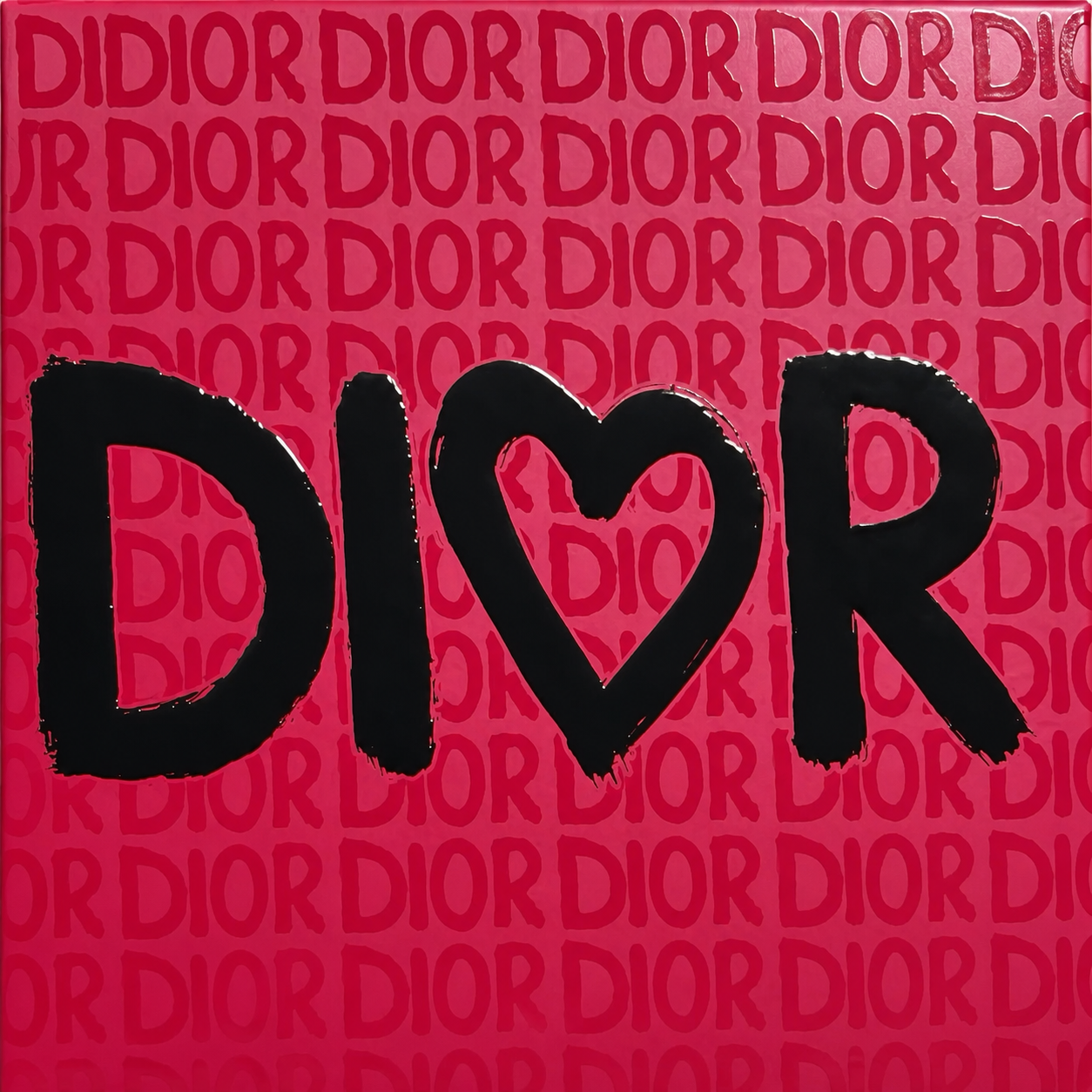
Spot UV creates contrast between coated and uncoated areas. The strength of this effect depends on both the gloss level of the UV coating and the surface underneath it.
A glossy logo on ordinary coated paper may create a subtle difference. The same logo applied over matte lamination normally creates much stronger contrast.
When spot UV works best
Spot UV is particularly effective when the artwork has one clear visual focal point. A carefully positioned glossy logo can look more refined than coating many unrelated parts of the design.
For very small lettering and thin lines, registration tolerance and coating flow must be considered. Fine elements may fill in, appear uneven or shift slightly relative to the printed artwork.
In our experience, simplifying thin lines before sampling often produces cleaner edges and more consistent results.
4. Spot UV Over Matte Lamination
One of the most recognizable premium packaging combinations is spot gloss UV over a matte-laminated surface.
The matte film reduces overall reflection, while localized UV coating restores high gloss to selected elements. This creates a clear contrast that becomes more visible when the package moves under light.
It is widely used for:
Cosmetic boxes
Perfume packaging
Skincare packaging
Electronics boxes
Luxury rigid boxes
Fashion packaging
Corporate gift boxes
This combination provides greater overall surface protection than spot UV applied directly to paper because the underlying lamination protects the entire printed sheet.
However, the UV coating must adhere properly to the selected film. Matte, soft-touch and anti-scratch films can have different surface properties, so adhesion testing is important before mass production.
Learn more about gloss, matte, soft-touch and specialty films in our packaging lamination guide.
5. Raised UV Coating
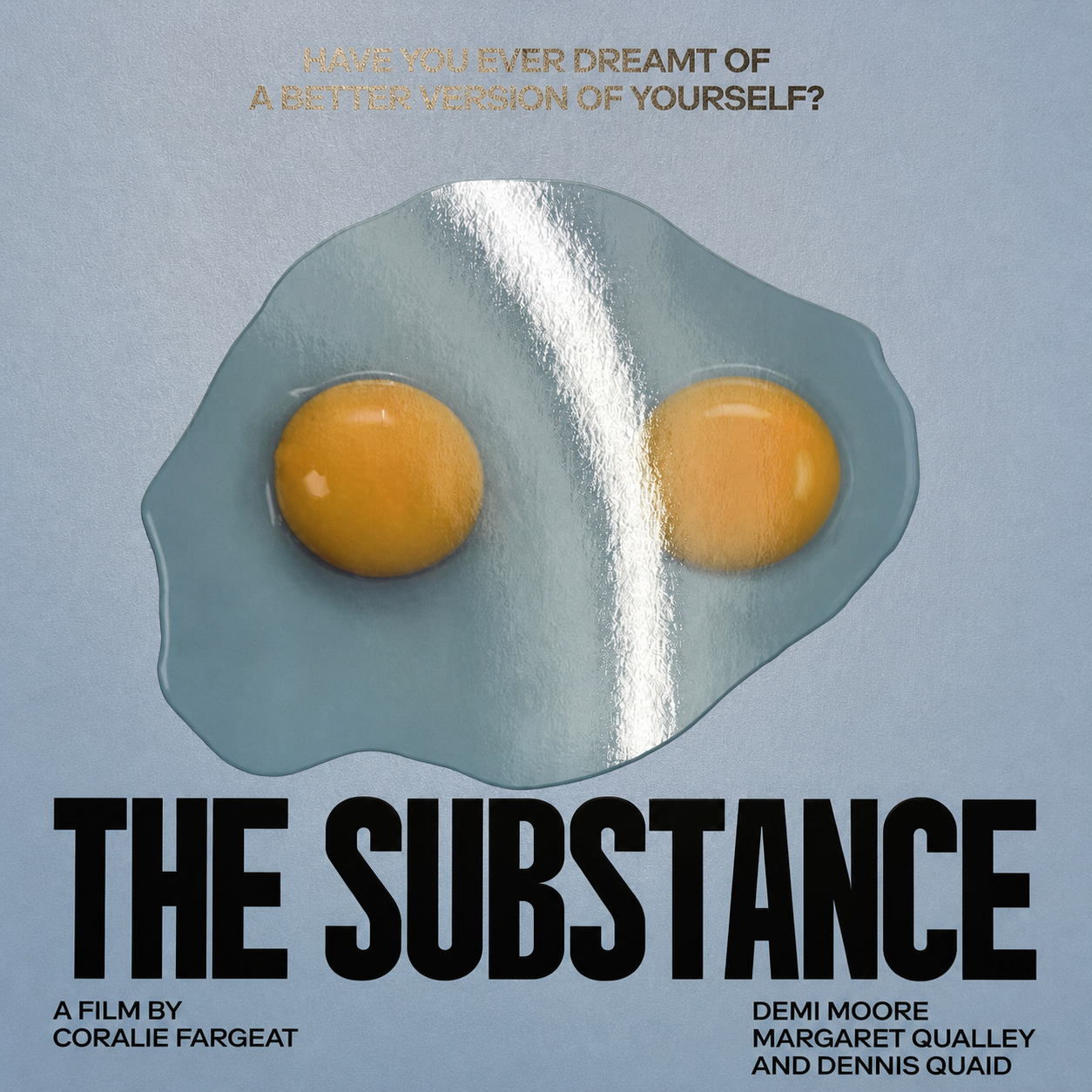
Raised UV uses a thicker coating deposit to create a visible and tactile layer above the printed surface.
Unlike embossing, raised UV does not physically reshape the paperboard using male and female dies. The dimensional effect is created by the coating itself.
Raised UV can be used for:
Logos
Large lettering
Water-droplet effects
Repeating patterns
Simulated textures
Product illustrations
Decorative borders
Raised UV vs embossing
| Comparison | Raised UV | Embossing |
|---|---|---|
| How the effect is created | Thick coating sits above the surface | Dies physically reshape the material |
| Main appearance | Usually glossy and dimensional | Raised paper or board |
| Tactile effect | Smooth, rounded or textured | Formed relief following the paper surface |
| Reverse-side effect | Usually none | May create a corresponding impression |
| Tooling | Application setup or screen | Custom embossing dies |
| Best for | Glossy tactile details | Sculpted logos and paper-based depth |
Raised UV is defined primarily by coating height. Its surface may be smooth or textured. When a raised coating is used to create a grain, droplet or material-like pattern, the effect may also be described as textured UV.
6. Textured UV Coating
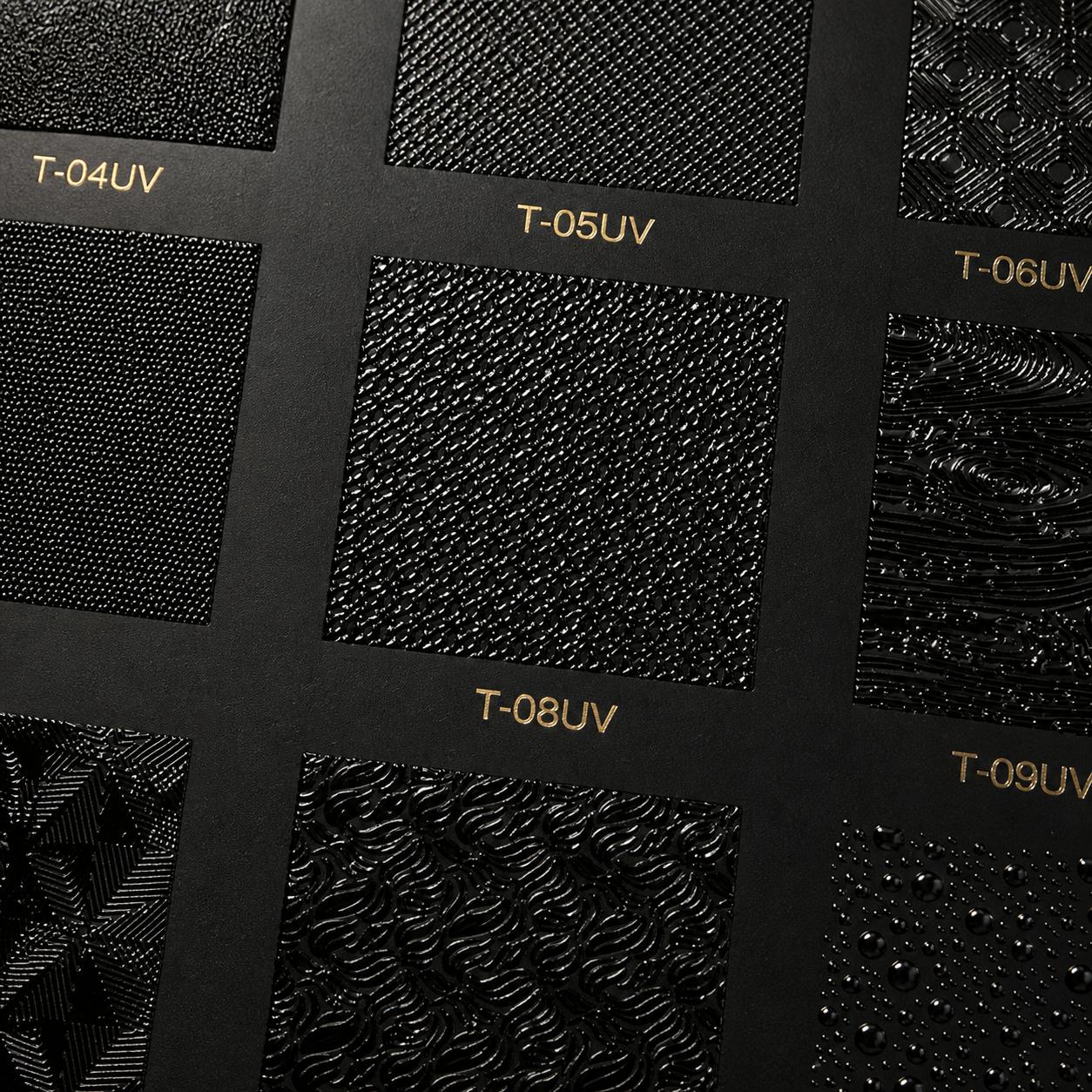
Textured UV coating creates a recognizable surface pattern or material-like feel. Unlike raised UV, which is defined mainly by coating height, textured UV is defined by the character of its surface.
A textured UV effect may be slightly raised, strongly raised or relatively flat, depending on the coating formulation, screen mesh and application method.
Common textured UV effects include:
- Fine sand or mineral texture
- Orange-peel texture
- Leather or reptile-inspired patterns
- Fabric and linen-like surfaces
- Frosted or grainy areas
- Repeating geometric patterns
- Water-droplet effect
Textured UV may be applied selectively or across a larger background area. It is commonly used for cosmetic packaging, promotional boxes, limited editions and designs that need a material-like tactile effect.
7. Reverse UV Coating
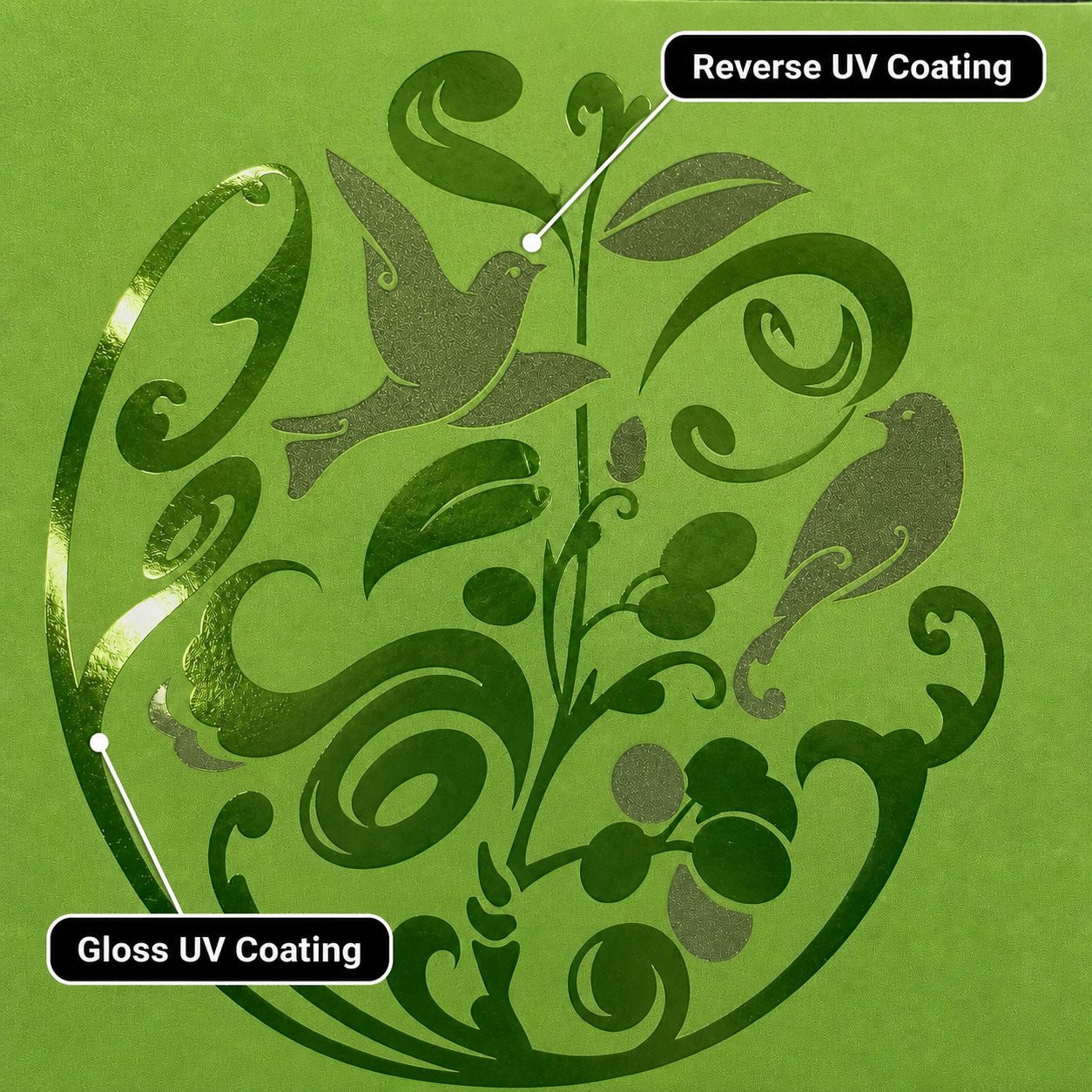
Reverse UV, also called drip-off UV or strike-through UV, creates contrasting matte and gloss areas through the interaction of two coatings.
A typical process works as follows:
The packaging artwork is printed.
A special matte or release varnish is applied to the areas intended to remain matte or textured.
A high-gloss coating is applied across the complete surface.
The two coatings interact differently in the selected and non-selected areas.
The finished surface is dried or UV-cured according to the coating system.
Where the special effect varnish has been applied, the gloss coating withdraws, separates or forms a lower-gloss texture. The remaining areas retain a smoother and more reflective appearance.
This process is known as “drip-off” because the high-gloss coating withdraws from the areas treated with the effect varnish. Heidelberg describes drip-off as a method for creating matte and gloss effects suitable for packaging and label applications.
Best applications for reverse UV
Reverse UV is commonly used for:
Cosmetic folding cartons
Skincare packaging
Perfume boxes
Electronics cartons
Pharmaceutical cartons
Food and beverage cartons
Book covers
Promotional packaging
Large repeating patterns
It works particularly well for fine lines, geometric backgrounds, subtle textures and designs containing extensive matte and gloss areas.
Reverse UV vs spot UV
| Comparison | Reverse UV | Spot UV |
|---|---|---|
| Basic process | Selective effect varnish followed by an overall coating | UV coating applied only to selected areas |
| Typical appearance | Matte, textured and gloss contrast | Clear localized high gloss |
| Best for | Large areas, patterns and fine matte–gloss effects | Logos, images, text and individual details |
| Surface level | Usually relatively flat | Can be flat, raised or textured |
| Overall coating | Normally applied across the surface | Not necessarily |
| Tactile effect | Subtle matte or grain contrast | Smooth gloss or raised coating |
| Relative cost | $$–$$$ | $$–$$$ |
Reverse UV can be more efficient for designs requiring broad matte–gloss contrast, but it does not normally create the same thick, glass-like appearance as raised spot UV.
The final result depends on the ink, varnish, coating formulation, substrate, coating weight and curing settings. A physical sample should be approved before mass production.
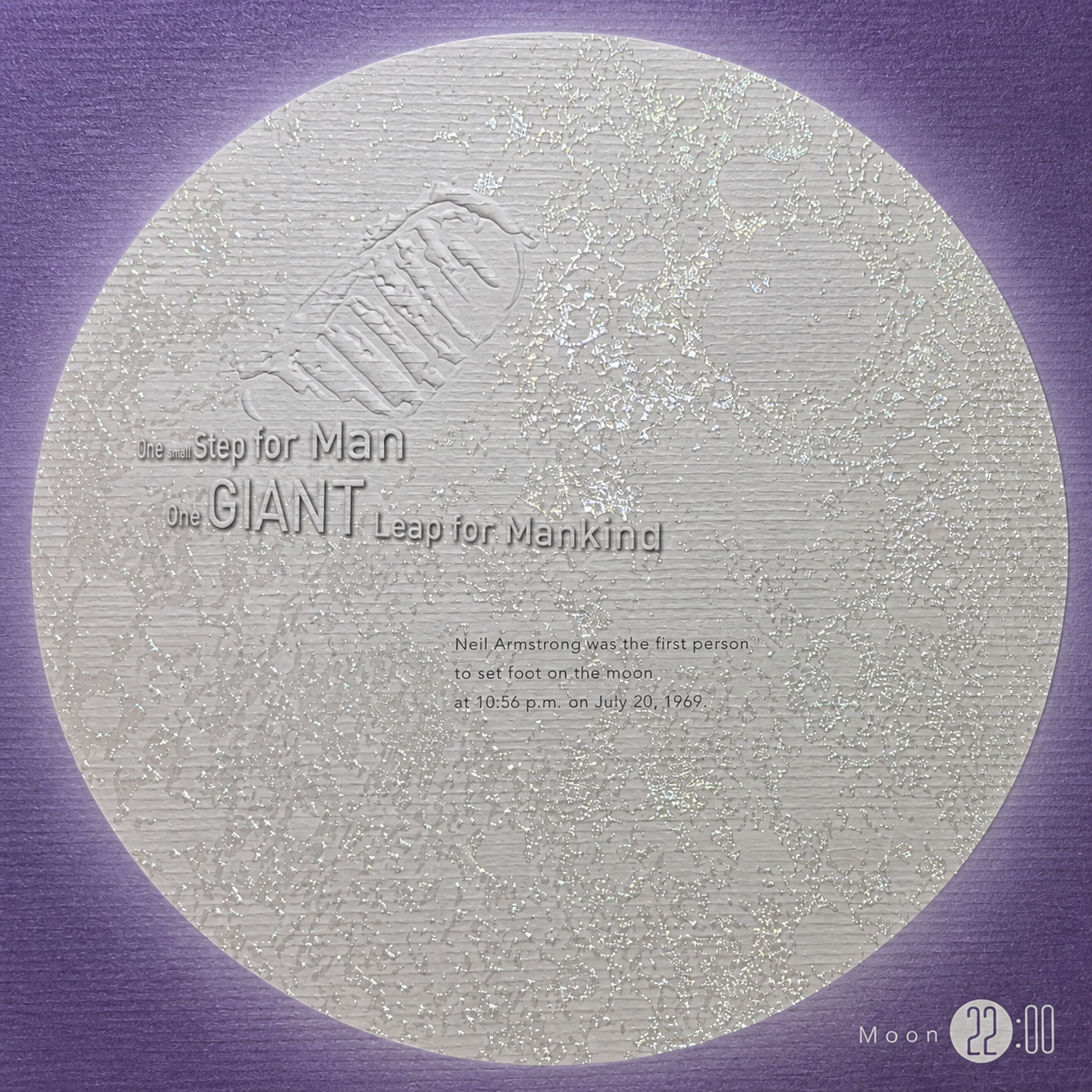
8. Pearlescent UV Coating
Pearlescent UV coating combines a UV-curable coating with fine pearlescent pigments.
These pigments reflect and scatter light, creating a soft shimmer that changes as the package is viewed from different angles. The effect is generally more restrained than glitter and more luminous than ordinary gloss UV.
Pearlescent UV can be applied:
Across the complete printed surface
To selected background areas
Over illustrations or patterns
Around logos and product names
As a subtle decorative layer over light colors
Best applications for pearlescent UV
Pearlescent UV is particularly suitable for:
Cosmetic packaging
Perfume packaging
Skincare boxes
Wedding and celebration packaging
Jewelry boxes
Premium confectionery packaging
Seasonal gift boxes
Iridescent visual concepts
The underlying printed color strongly affects the final result. Light backgrounds generally create a softer and cleaner pearl effect, while dark backgrounds may produce stronger contrast.
Pigment size, pigment density, coating thickness and viewing angle all affect the visibility of the shimmer.
Design considerations
Pearlescent UV should be evaluated using a physical sample because a digital proof cannot reproduce its reflective behavior.
For better results:
Use sufficiently large coated areas.
Avoid relying on the effect to reproduce very small text.
Confirm whether the effect should be subtle or highly visible.
Test the coating over the actual printed color.
Evaluate the sample under daylight and retail lighting.
Confirm compatibility with later foil stamping and gluing.
Pearlescent UV is not the same as pearlescent lamination. Lamination applies a separate specialty film, while pearlescent UV creates the effect using reflective pigments contained in a cured liquid coating.
9. Glitter UV Coating
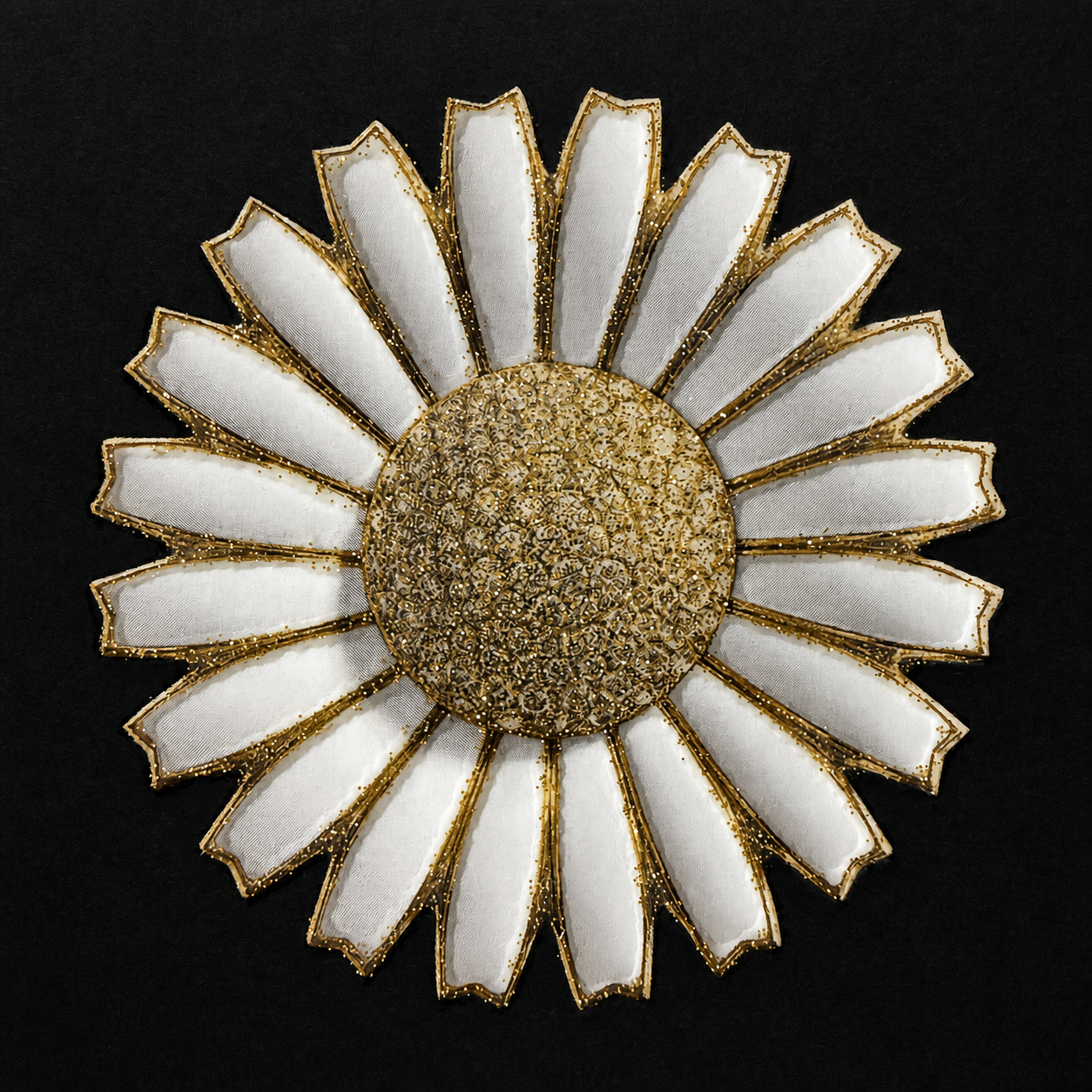
Glitter UV coating contains reflective particles suspended in a UV-curable coating. After application and curing, the surface produces a visible sparkling effect.
It may also be called sparkle UV, glitter varnish or glitter screen coating.
Compared with pearlescent UV, glitter UV usually has:
Larger and more visible reflective particles
Stronger points of light
A bolder decorative appearance
More noticeable surface texture
Greater coating thickness
Best applications for glitter UV
Glitter UV is commonly used for:
Holiday gift boxes
Cosmetics packaging
Children’s product packaging
Promotional packaging
Limited-edition products
Wedding and celebration boxes
Fashion accessories
Decorative stationery
Beverage gift packaging
It can cover a complete surface, but selective application is usually more effective because it prevents the sparkle from overwhelming typography and main branding.
Factors affecting the result
The appearance and cost of glitter UV depend on:
Glitter particle size
Particle color
Particle density
Coating thickness
Coated area
Application method
Underlying printed color
Number of production passes
Required rub and adhesion resistance
Larger particles generally create stronger sparkle but require a heavier coating deposit and may not reproduce fine artwork cleanly.
Glitter UV should not extend across fold lines, glue areas or small legal text. For packaging that will experience frequent rubbing, conduct adhesion and rub tests to confirm that the particles remain securely encapsulated in the cured coating.
Glitter UV is different from glitter ink, metallic ink and foil stamping. Glitter UV creates sparkle through reflective particles contained in the surface coating, while foil stamping applies a continuous metallic or holographic foil layer.
UV Coating vs Conventional Varnish
The terms “UV coating” and “UV varnish” are sometimes used interchangeably by packaging suppliers.
Varnish generally refers to a relatively thin liquid coating applied over printing. UV describes the curing method. Therefore, one supplier may describe a thin UV-cured coating as UV varnish, while another may reserve “UV coating” for a heavier or glossier application.
For purchasing purposes, the name alone is not enough. Confirm:
Whether the coating is cured using UV energy
Whether it is applied overall or selectively
The expected gloss level
The approximate coating thickness
Whether the effect is flat, raised or textured
The application method
Whether another protective layer is applied underneath
Whether the effect contains pearl or glitter particles
For a broader comparison of gloss, matte and protective varnishes, see our packaging varnishing guide.
UV Coating vs Lamination
UV coating and lamination can both change appearance and improve surface protection, but they are not interchangeable.
| Comparison | UV Coating | Lamination |
|---|---|---|
| Material applied | Liquid coating cured on the surface | Separate film bonded to the sheet |
| Main appearance | High gloss, selective contrast or tactile detail | Gloss, matte, soft-touch or specialty film |
| Surface protection | Light to moderate, depending on formulation | Generally stronger |
| Moisture resistance | Limited to moderate | Generally stronger |
| Edge protection | Limited | Better across the laminated surface, although cut edges remain exposed |
| Spot application | Common | Usually covers the complete sheet |
| Tactile options | Raised, textured, pearl and glitter effects | Soft-touch, textured and specialty films |
| Cost | Depends on setup, coverage and thickness | Depends on film type and surface area |
| Best use | Gloss contrast and selective decoration | Uniform protection and full-surface appearance |
Choose UV coating for localized contrast, brilliant gloss or dimensional details. Choose lamination when the priority is stronger full-surface protection, a consistent matte effect or a soft-touch feel.
The two processes can also be combined, especially when spot UV is applied over matte lamination.
UV Coating vs Screen Printing
UV coating and screen printing are not directly opposing processes.
UV coating describes the coating material and curing system. Screen printing describes a method used to transfer ink or coating onto the packaging surface.
A UV-curable coating can therefore be applied through screen printing. This is particularly common for spot UV, raised UV, textured UV, pearlescent UV and glitter UV because screen printing can deposit a relatively thick coating layer.
Screen printing can also apply:
Conventional printing ink
UV-curable ink
Metallic ink
Opaque white ink
Specialty varnish
Adhesive
Glitter coating
Raised tactile coating
UV coating vs screen printing at a glance
| Comparison | UV Coating | Screen Printing |
|---|---|---|
| What it describes | A coating and curing system | An application and printing method |
| Material applied | Clear or specialty UV-curable coating | Ink, varnish, adhesive or specialty coating |
| Curing method | Ultraviolet energy | May use UV, heat or air drying |
| Typical coverage | Overall or selective | Usually selective |
| Coating thickness | Thin to relatively thick | Particularly suitable for thick deposits |
| Best for | Gloss, protection and surface effects | Opaque color, spot effects, texture and raised coating |
| Photographic detail | Depends on the application method | Generally less suitable than offset for fine photographic reproduction |
| Common packaging uses | Overall UV, spot UV and gloss protection | Raised UV, glitter UV, texture and opaque specialty printing |
| Setup cost | Depends on coating and application system | Usually requires a screen and separate setup |
| Variable cost | Coated area, formulation and thickness | Material consumption, passes and production time |
When to choose overall UV coating
Choose an overall UV coating when you need:
Uniform gloss across a large surface
Brighter printed colors
Efficient full-sheet coating
Light-to-moderate protection
Consistent coverage on folding cartons
An inline coating unit is generally more efficient for large overall areas than screen printing.
When to choose screen-applied UV coating
Choose screen-applied UV when you need:
Raised UV
Thick spot gloss
Glitter particles
Pearlescent or textured areas
Strong tactile contrast
Selective logos or patterns
A heavier coating deposit
Instead of asking whether to use “UV coating or screen printing,” ask the packaging supplier:
Which application method is most suitable for the required UV coating effect?
The supplier may recommend an offset coating unit, flexographic coating unit, screen printing, digital embellishment or another application method depending on the artwork, thickness, substrate and production quantity.
Which Materials Work Best With UV Coating?
UV coating generally performs best on smooth, coated and properly prepared surfaces.
Suitable substrates may include
Coated art paper
Coated paperboard
Printed folding carton stock
Laminated wrapping paper
Selected synthetic papers
Some metallic and specialty papers after testing
Materials requiring more care
Uncoated paper
Porous paper can absorb liquid coating, reducing gloss and making the effect appear uneven. A primer, sealer or base coating may be necessary.
Kraft paper
Natural kraft has a rough and absorbent surface. Spot UV may look more subtle than expected, and fine details may not remain as sharp as they would on coated paper.
Textured paper
The coating follows the underlying texture and may not form a perfectly level glossy surface. This can be desirable, but it must be evaluated using a physical sample.
Metallic or specialty paper
Surface energy, existing coatings and reflective layers can affect adhesion. Compatibility testing is required.
Soft-touch and anti-scratch film
These films can create excellent visual contrast with spot UV, but the coating system must be formulated to adhere to the selected film.
What Protection Does UV Coating Provide?
A cured UV coating can improve resistance to:
Light rubbing
Surface dirt
Minor scuffing
Routine handling
Limited surface moisture
Color wear on frequently touched areas
Protection varies according to the formulation, coating thickness, substrate and curing quality.
UV coating should not be treated as a waterproof barrier. It does not fully protect exposed paper edges, folds, corners or uncoated glue areas.
For packaging that will experience frequent handling, long-distance transportation or humid conditions, compare UV coating with lamination before selecting the finish.
Artwork Guidelines for Spot and Specialty UV
Good production results begin with a coating file that is practical to manufacture.
Recommended artwork preparation
Create the UV area as a separate vector layer.
Use a clearly named spot color such as “SPOT UV.”
Set the coating artwork to 100% solid color.
Keep the coating layer aligned with the printed artwork.
Avoid unsupported gradients and transparent effects.
Avoid extremely fine lines and tiny gaps.
Keep thick UV areas away from folds and cut edges.
Identify areas that must remain coating-free for gluing or coding.
Separate pearlescent, glitter and reverse UV layers clearly.
Confirm registration tolerance with the supplier.
Common artwork problems
Coating lines are too thin to reproduce consistently.
Spot UV extends across creases and cracks during folding.
The coating covers glue areas and weakens adhesion.
Raised UV is too thick near a die-cut edge.
Small text fills in and becomes difficult to read.
Printed and UV layers do not align perfectly.
Glitter particles obscure fine graphic details.
The selected film does not provide reliable coating adhesion.
For critical logos, fine patterns and specialty effects, approve a physical production sample rather than relying only on a digital proof.
What Determines UV Coating Cost?
UV coating cost includes setup expenses and variable production expenses.
| Cost Factor | How It Affects Price |
|---|---|
| Application setup | Spot, raised and specialty UV require dedicated preparation |
| Coated area | Larger areas consume more coating |
| Coating thickness | Raised and glitter effects require more material |
| Number of coating effects | Multiple UV formulations add setup and production stages |
| Registration accuracy | Fine alignment requires tighter production control |
| Particle type | Pearlescent and glitter pigments add material cost |
| Substrate | Porous or specialty materials may require primer and testing |
| Underlying finish | Matte or soft-touch film adds a separate lamination cost |
| Order quantity | Setup cost is distributed across more units at higher quantities |
| Sampling | Custom physical samples add pre-production expense |
| Number of passes | Complex effects may require several coating or curing stages |
Overall UV is generally more economical than complex raised, pearl, glitter or textured UV.
Spot UV can add meaningful setup cost even when the coated area is small because selective application still requires separate production preparation.
Recommended UV Finish by Objective
| Your Objective | Recommended Option |
|---|---|
| Brighten the entire printed surface | Overall gloss UV |
| Reduce reflection across the package | Overall matte UV |
| Highlight a logo economically | Simple spot UV |
| Create glossy contrast on a matte box | Spot UV over matte lamination |
| Create fine matte and gloss patterns | Reverse UV |
| Add tactile glossy lettering | Raised UV |
| Create water drops or patterned texture | Textured or raised UV |
| Add a soft angle-dependent shimmer | Pearlescent UV |
| Create bold sparkling decoration | Glitter UV |
| Apply a thick specialty coating | Screen-applied UV |
| Obtain stronger full-surface protection | Lamination |
| Apply metallic detail | Foil stamping |
| Create depth by reshaping the paperboard | Embossing |
Common UV Coating Problems and Prevention
Poor adhesion
The UV layer may peel or scratch away if it is incompatible with the ink, substrate or laminated surface.
Prevention: Test the actual combination of paper, ink, film and coating before mass production.
Cracking at folds
A heavy coating layer can crack when the sheet is creased and folded.
Prevention: Avoid heavy UV across fold lines and confirm the creasing method and board grain direction.
Misregistration
The UV coating may shift slightly relative to the printed logo or text.
Prevention: Avoid unnecessarily tight outlines and allow practical registration tolerance.
Pinholes or uneven gloss
Porous paper, dust or contamination can produce an inconsistent surface.
Prevention: Use an appropriate coated stock, primer or sealer and maintain clean production conditions.
Insufficient curing
An inadequately cured coating may remain tacky, produce odor or stick to adjacent sheets.
Prevention: Confirm coating formulation, lamp output, production speed and coating thickness.
Particle loss
Glitter particles may become loose if the coating does not fully encapsulate them.
Prevention: Conduct adhesion and rub testing on the final production sample.
Fingerprints
Very glossy dark surfaces can reveal fingerprints under strong lighting.
Prevention: Evaluate the finish under actual retail and handling conditions before approval.
Is UV Coating Sustainable?
UV-cured coatings are often described as low-VOC options because most of the applied formulation becomes part of the cured coating rather than drying through the evaporation of large quantities of solvent.
The U.S. Environmental Protection Agency includes UV-cured coatings among examples of low- or no-VOC/HAP coating technologies. However, “UV-cured” does not automatically mean VOC-free, recyclable, compostable or environmentally preferable in every application.
The environmental result depends on:
The coating formulation
Coating thickness
Paperboard composition
Inks and adhesives
Lamination and foil
Glitter or pearlescent particles
Deinking and repulping performance
Local recycling infrastructure
Manufacturing energy source
Evaluate sustainability using the complete packaging structure rather than making a claim based only on the curing method.
Can UV Coating Be Used on Food Packaging?
UV coating may be used on the outside of some food packaging, but suitability must be confirmed for the specific application.
The supplier should evaluate:
Whether the coating has direct or indirect food contact
Functional barriers between the coating and food
Migration and odor requirements
Regulations in the destination market
Curing completeness
Storage temperature and duration
The type of food being packed
The suitability of pearlescent or glitter particles
Do not assume that a general-purpose UV coating is approved for direct food contact. Request formulation documentation and compliance testing when required.
How to Specify UV Coating in a Quotation
To obtain an accurate quotation, provide:
Packaging structure
Finished dimensions
Paper or paperboard material
Printing method and colors
Required UV coating type
Exact coated artwork area
Desired gloss, shimmer, sparkle or tactile effect
Underlying lamination or varnish
Order quantity
Target market
Performance requirements
Sample expectations
Delivery schedule
Instead of writing only “spot UV,” describe the intended result. For example:
High-gloss raised spot UV on the logo and water-drop pattern over anti-scratch matte lamination, with no coating across fold or glue areas.
For reverse UV, specify which areas should appear matte and which should remain glossy.
For pearlescent and glitter UV, provide a physical reference or describe the desired particle size, density, color and intensity.
Frequently Asked Questions
Is UV coating the same as spot UV?
No. UV coating describes a coating cured using ultraviolet energy. It may cover the complete surface or selected areas. Spot UV specifically means the coating is applied only to designated parts of the artwork.
Is UV coating the same as UV printing?
No. UV printing normally refers to printing ink cured using ultraviolet energy. UV coating is a clear or specialty layer applied over the printed surface. A package may use conventional printing with UV coating, UV printing without an additional coating, or both.
Is UV coating waterproof?
No. It can provide limited surface moisture resistance, but it does not make the complete package waterproof. Cut edges, folds, seams and uncoated areas remain vulnerable to moisture.
Does spot UV need matte lamination?
Not always. Spot UV can be applied directly to suitable printed and coated paper. Matte lamination is frequently used underneath because it creates stronger gloss contrast and improves overall protection.
Can spot UV be applied over soft-touch lamination?
Yes, but adhesion depends on the particular soft-touch film and UV formulation. The exact combination should be tested before production.
Can UV coating crack on folding cartons?
It can crack if a heavy coating crosses a crease or if the board, grain direction and creasing setup are unsuitable. Keep thick UV effects away from fold lines wherever possible.
Is raised UV the same as embossing?
No. Raised UV builds height by depositing a thick coating on top of the surface. Embossing uses dies to physically reshape the paper or paperboard.
What is reverse UV coating?
Reverse UV, also called drip-off UV, creates matte and gloss contrast by applying a selective effect varnish followed by an overall coating. The coatings interact differently in selected areas, producing a combination of lower-gloss texture and high-gloss surfaces.
Is reverse UV the same as spot UV?
No. Spot UV applies UV coating directly to selected elements. Reverse UV normally uses a selective effect varnish together with an overall coating to create contrasting matte and gloss areas.
What is pearlescent UV coating?
Pearlescent UV is a UV-curable coating containing fine reflective pigments. It creates a soft shimmer that changes with lighting and viewing angle.
What is glitter UV coating?
Glitter UV contains visible sparkling particles suspended in a cured coating. It creates a bolder and more textured effect than pearlescent UV and is commonly used selectively on seasonal, beauty and promotional packaging.
Is UV coating the same as screen printing?
No. UV coating is a coating cured using ultraviolet energy, while screen printing is a method of applying ink or coating. UV coating can be applied through screen printing, particularly for raised, textured, pearlescent and glitter effects.
Which is better for raised effects: UV coating or screen printing?
Raised UV is the coating effect, while screen printing is one method used to produce it. Screen printing is often selected because it can deposit a thicker coating layer. The best method depends on the required height, artwork, substrate and production quantity.
Is UV coating suitable for kraft paper?
It may be used on kraft paper, but the porous and textured surface can absorb the coating and reduce gloss. A primer or sealer may be required, and a physical sample is recommended.
Is UV coating more expensive than varnish?
Standard overall UV may be moderately more expensive than a simple conventional varnish. Spot, reverse, raised, pearlescent, glitter and textured UV usually cost more because they require additional setup and production control.
Can UV-coated packaging be recycled?
It depends on the coating, substrate, particles and complete packaging construction, as well as local recycling capabilities. UV coating alone should not be used as proof that a package is recyclable or non-recyclable.
Choosing the Right UV Coating
Choose overall gloss UV when the main objective is brighter color and a consistently reflective surface.
Choose spot UV when selected logos, images or patterns need emphasis. Use spot UV over matte lamination for strong premium contrast and raised UV when the design requires a dimensional tactile feature.
Choose reverse UV for detailed matte–gloss patterns across larger areas, pearlescent UV for a refined angle-dependent shimmer and glitter UV for a bold sparkling effect.
If the priority is stronger full-surface protection, lamination may be more suitable. If the goal is economical and subtle surface protection, conventional varnishing may be sufficient.
UV coating is one option within a broader system of custom packaging finishes. The right solution depends on the material, package structure, artwork, handling conditions, budget and desired customer experience.
Send us your packaging design, product dimensions, preferred material and order quantity through our contact page. We can recommend an appropriate UV coating, determine whether it should be applied through a coating unit, screen printing or another method, and prepare a custom quotation or physical sample.