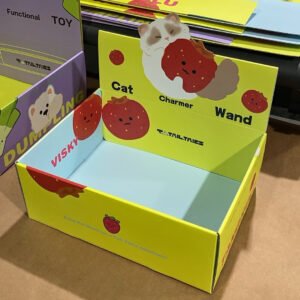
Flexographic printing—commonly called flexo printing—is one of the most important printing processes for corrugated boxes, paper bags, labels, flexible packaging, tissue paper and many other roll-fed packaging materials.
Its main strength is not simply speed. Flexography combines flexible relief printing plates, controlled ink transfer through an anilox roller, relatively light printing pressure and continuous production, allowing it to print efficiently on materials ranging from absorbent kraft paper to selected plastic films.
For packaging buyers, this creates an important question: When should flexographic printing be chosen instead of offset, digital or gravure printing?
The answer depends on the substrate, artwork, quantity, ink requirements, packaging format and required print quality.
Quick Answer: Flexographic printing is a direct relief-printing process that uses flexible printing plates and an anilox roller to transfer a controlled amount of ink onto the substrate. It is particularly suitable for corrugated board, kraft paper, paper bags, labels, tissue paper and flexible films, especially when continuous or higher-volume production is required. Modern flexography can reproduce both spot colors and CMYK process graphics, although the final result depends strongly on the substrate, plate, anilox, ink and press configuration.
Flexographic Printing at a Glance
| Factor | Flexographic Printing |
|---|---|
| Printing Principle | Direct relief printing |
| Printing Plate | Flexible photopolymer or other flexographic relief plate |
| Ink Control | Anilox roller meters ink transferred to the plate |
| Common Color Systems | Spot colors, Pantone colors and CMYK process printing |
| Best Suited For | Medium-to-large repeat production, especially roll-fed packaging |
| Common Substrates | Kraft paper, coated/uncoated paper, corrugated board, labels and selected films |
| Flexible Films | BOPP, PET, PE and other compatible films depending on ink/press |
| Common Inks | Water-based, solvent-based and UV-curable systems depending on application |
| Printing Pressure | Relatively light compared with some conventional processes |
| Variable Data | Not a native strength; digital printing is generally better |
| Plate Cost | Required, creating an initial setup cost |
| Production Speed | High once the press is set up |
| Common Applications | Corrugated boxes, bags, labels, wrappers, flexible packaging and tissue paper |
What Is Flexographic Printing?
Flexographic printing is a direct relief-printing process.
The printing plate contains raised image areas and recessed non-image areas. Ink is applied to the raised areas and then transferred directly onto the substrate.
Modern flexographic plates are commonly made from photopolymer materials, although rubber plates have also historically been used. Improvements in photopolymer plates, anilox technology and press control have significantly expanded the quality that modern flexography can achieve.
A simplified flexographic printing system contains:
Ink system → anilox roller → printing plate → substrate → impression cylinder
Unlike offset printing, there is no rubber blanket between the printing plate and the substrate.
The flexographic plate transfers the image directly.
How Does Flexographic Printing Work?
Although equipment configurations differ, the basic process can be understood through four functions.
1. Ink Delivery
Ink is supplied to the printing unit.
Depending on the packaging application, flexographic printing may use:
- water-based inks,
- solvent-based inks,
- UV-curable inks,
- or other application-specific formulations.
The appropriate system depends on the substrate, press, drying requirements, packaging application and subsequent converting processes. Water-based flexo is widely used on paper and corrugated applications, while solvent, water-based and UV systems can all appear in flexible-packaging production depending on requirements.
2. Anilox Metering
The anilox roller is one of the defining components of flexographic printing.
Its surface contains a large number of microscopic engraved cells.
These cells carry a controlled volume of ink and transfer it to the printing plate.
This matters because flexographic print quality is not determined by the plate alone.
The anilox cell volume and cell count influence factors such as:
- ink deposit,
- color density,
- solid coverage,
- fine-detail reproduction,
- tonal range.
For this reason, the anilox is often described as the “heart” of the flexographic press.
3. Plate-to-Substrate Transfer
The anilox transfers ink to the raised image areas of the flexible printing plate.
The plate then contacts the substrate under controlled pressure and transfers the image directly onto it.
Because the plate is flexible and printing pressure can be relatively light, flexography can be suitable for materials that should not be subjected to excessive printing pressure.
4. Drying or Curing
After each color is transferred, the ink must reach the appropriate dry or cured state before subsequent printing or converting.
The exact method depends on the ink system.
Once printing is complete, roll-fed materials may proceed into additional converting operations such as coating, lamination, slitting, die cutting or rewinding depending on the package.
Why Is the Anilox Roller So Important?
One of the biggest differences between flexographic printing and other printing methods is how precisely ink volume is controlled through the anilox.
Different artwork elements require different ink-transfer characteristics.
A large solid logo may need different ink-film characteristics from a fine photographic highlight.
This creates a production relationship:
Artwork → plate → anilox → ink → substrate
Changing one component can affect the others.
For example, increasing ink volume does not automatically improve print quality. Too much ink can reduce fine-detail definition, while too little can weaken solid color density.
The correct anilox specification therefore depends on what is being printed.
This is one reason modern flexography should not be judged simply as a “low-resolution” printing process.
What Materials Can Be Flexographically Printed?
One of flexography’s strongest advantages is substrate versatility.
Kraft Paper and Uncoated Paper
Flexography is widely used for kraft paper applications such as:
- paper bags,
- wrapping papers,
- corrugated packaging,
- envelopes,
- and other paper packaging.
However, uncoated paper absorbs ink differently from coated paper.
This can influence:
- color density,
- dot definition,
- fine details,
- drying,
- and perceived sharpness.
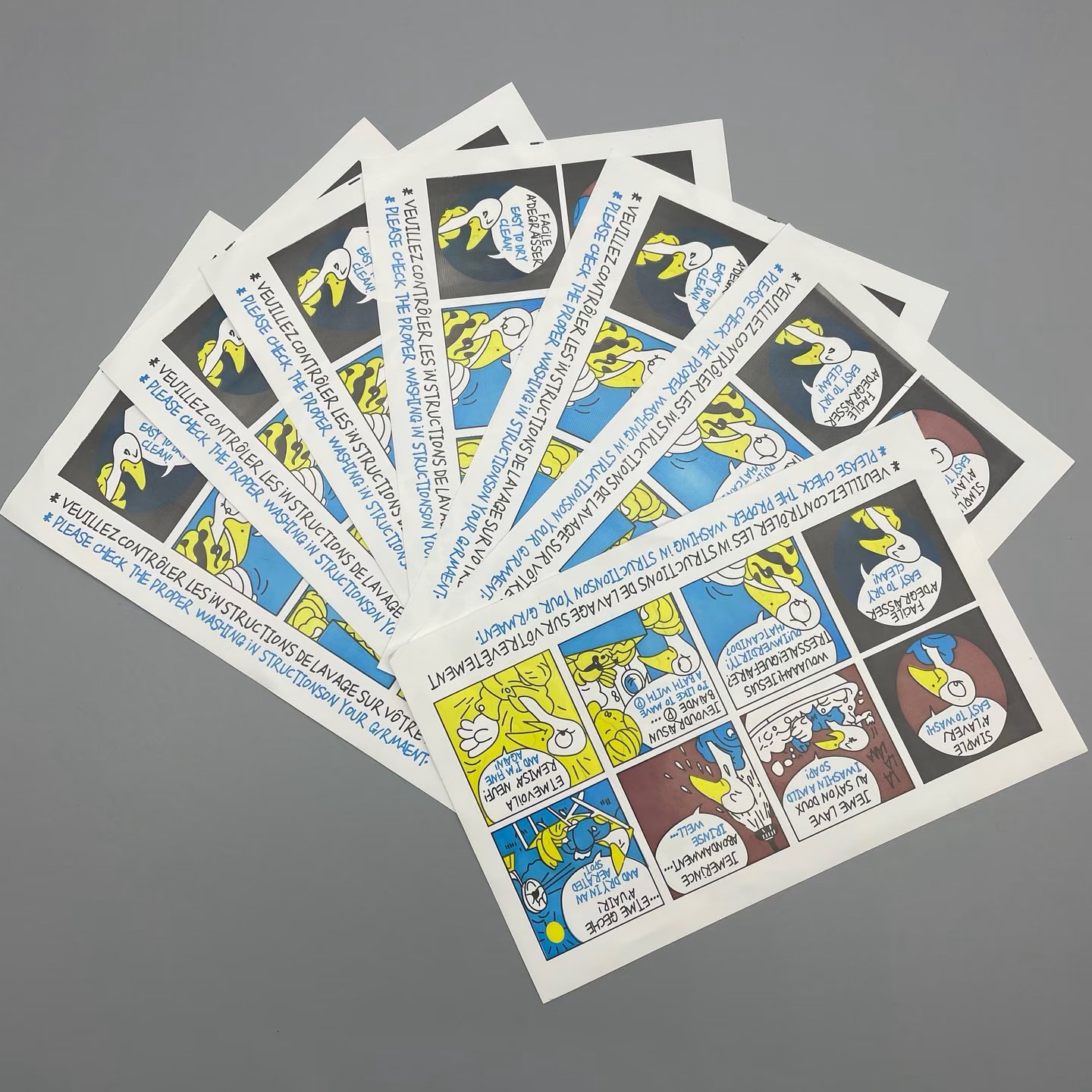
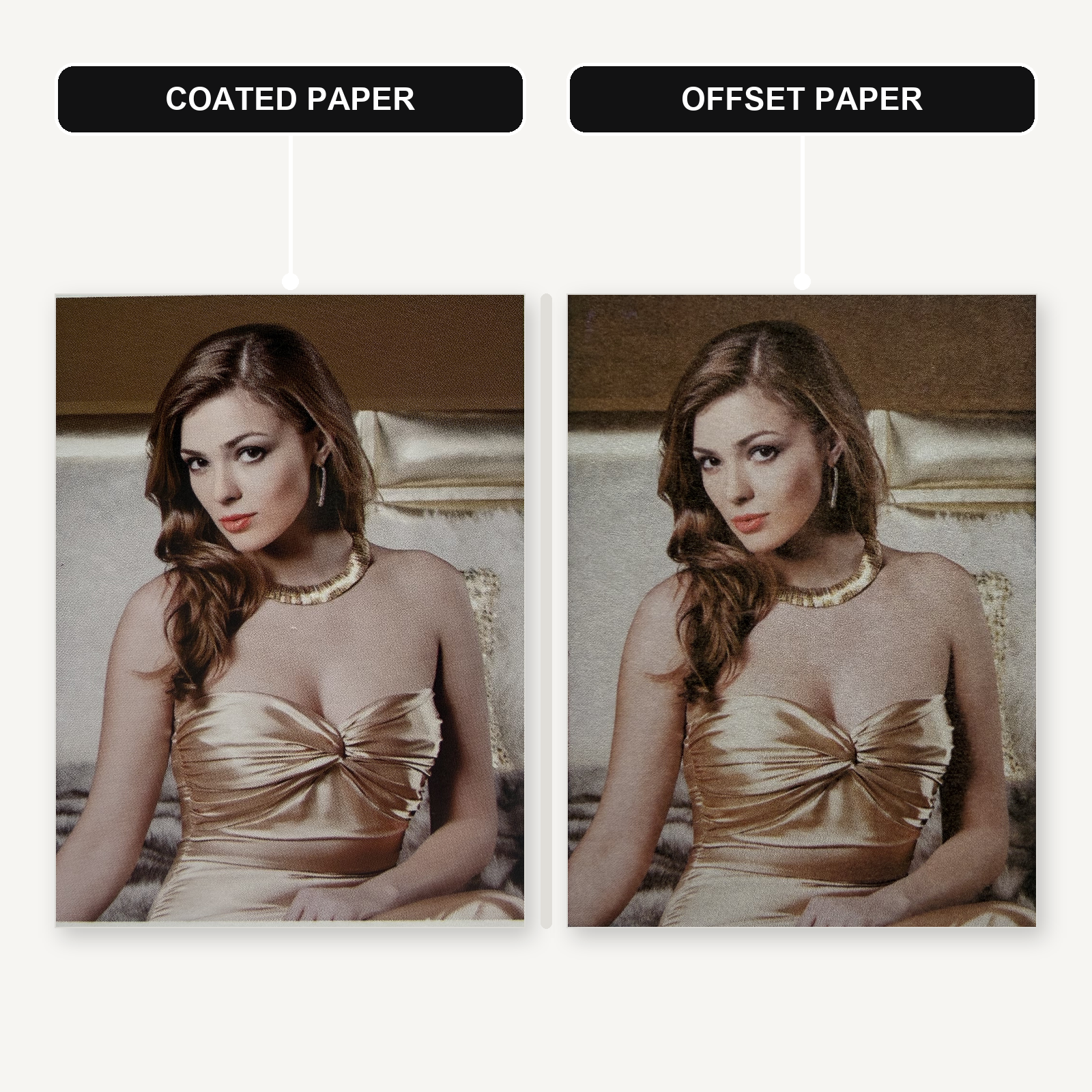
Your supplied physical samples illustrate this well: the same type of CMYK flexographic image printed on coated and uncoated papers can produce visibly different results.
This does not necessarily mean one print is “wrong.”
It demonstrates that the substrate is part of the printing system.
Coated Paper
Smoother coated papers generally provide a more controlled surface for fine graphics and process printing.
Depending on the press and packaging construction, flexography can therefore be used for more than simple kraft-paper graphics.
Corrugated Board
Corrugated packaging is one of flexography’s major applications.
Because corrugated board can vary significantly in surface smoothness and absorbency, direct flexographic printing requires appropriate control of:
- plate pressure,
- ink formulation,
- anilox selection,
- board surface,
- and registration.
The Flexographic Technical Association specifically notes that different corrugated surfaces—from brown kraft to coated board—have different absorption characteristics and therefore require different ink-film considerations.
Flexo is therefore especially useful for direct printing on shipping cartons, mailers and other corrugated packaging where the graphics can be applied without first printing and mounting a separate lithographic sheet.
Flexible Films
Flexographic printing is also widely used for flexible packaging.
Depending on the press, ink system and surface treatment, compatible substrates can include materials such as:
- BOPP,
- PET,
- PE,
- PP,
- and other flexible films or laminates.
Non-porous films behave very differently from paper. Surface energy, wetting, adhesion and drying therefore become more important. Corona treatment or other surface preparation may sometimes be used to improve ink wettability and adhesion.
The material should always be tested with the intended ink and final packaging construction.
Flexographic Printing on Coated vs. Uncoated Paper
The physical samples supplied for this guide provide a useful comparison.
The same type of CMYK artwork can appear different when flexographically printed onto coated and uncoated paper.
On a smoother coated surface, ink remains closer to the surface and fine image reproduction can appear cleaner.
On a more absorbent uncoated stock, ink can penetrate the material more readily, influencing:
- density,
- contrast,
- dot appearance,
- and overall color character.
This principle is especially important when a brand changes packaging paper but expects the printed color to remain identical.
Changing the paper can change the print—even when the artwork and printing process remain the same.
For color-critical packaging, physical proofing on the intended production substrate is therefore more useful than approving color only from a monitor or from a different paper stock.
Can Flexographic Printing Produce CMYK Images?
Yes.
Modern flexographic printing can reproduce CMYK process artwork as well as spot-color designs.
Standard CMYK uses:
- Cyan
- Magenta
- Yellow
- Black
printed in controlled halftone patterns to create full-color images.
Historically, flexography was strongly associated with relatively simple line graphics and solid colors. Advances in photopolymer plates, anilox technology and press control have significantly improved process-image reproduction.
However, the final quality still depends on:
- substrate smoothness,
- plate technology,
- anilox specification,
- registration,
- ink,
- artwork preparation,
- and press capability.
Therefore:
“Flexo can print CMYK” does not mean every flexographic press produces the same photographic quality.
Can Flexographic Printing Use Pantone and Spot Colors?
Yes.
Spot-color printing is one of flexography’s important strengths.
A packaging design can use:
CMYK + spot colors
or, for simpler graphics:
spot colors only
Each independently printed color normally requires its own printing plate and color station.
This makes flexography particularly suitable for packaging with:
- brand colors,
- large solid areas,
- simple logos,
- repeated graphic elements,
- and consistent spot-color requirements.
Pantone specifications can be used as color targets, but the final appearance still depends on substrate color, ink formulation, ink film and surface characteristics.
A Pantone color printed on brown kraft will not necessarily look identical to the same color printed on coated white paper.
What Inks Are Used in Flexographic Printing?
There is no single “flexo ink.”
The ink system should be selected according to the substrate and application.
| Ink Type | Typical Characteristics | Packaging Considerations |
|---|---|---|
| Water-Based | Common for paper, paperboard and corrugated; also used in selected flexible applications | Drying, substrate absorption, wetting and end-use resistance must be considered |
| Solvent-Based | Fast drying and widely used in flexible packaging | VOC control, handling and lamination requirements matter |
| UV-Curable | Cures rapidly under UV energy and can provide strong print properties | Equipment, substrate and end-use compatibility must be confirmed |
Water-based inks are often described as a more environmentally favorable alternative to solvent systems because they can reduce VOC emissions, but that does not mean every water-based ink or flexographic package is automatically sustainable.
Drying energy, substrate structure, coatings, laminations, ink chemistry and recyclability of the complete package still matter.
A Real Production Example: Metallic Silver Flexographic Printing
Flexographic printing is sometimes treated as a process mainly for ordinary solid colors, but the relationship between ink and substrate can create more specialized applications.
In one Vigor Packaging project, the customer wanted 80 gsm white kraft paper printed with a metallic silver pattern while maintaining a relatively thick and less transparent paper.
During trial production, we evaluated offset silver and screen-printed silver on the specified white kraft.
The offset result appeared relatively dark and subdued.
Screen printing produced a brighter and glossier result, but the reflected brightness still did not provide the distinct metallic silver character the customer wanted.
Instead of compromising the paper thickness requirement, we changed another part of the production system.
We tested 80 gsm machine-glazed (MG) paper with flexographic silver printing.
This combination produced the desired metallic appearance while maintaining the customer’s thickness requirement.
You can see the complete production analysis in our Metallic Silver Printing on Tissue Paper case study.
The important lesson is not simply that flexography produced the best result.
It is that:
The printing process, ink and substrate should be evaluated together.
The same metallic ink concept can behave differently when the paper surface and printing method change.
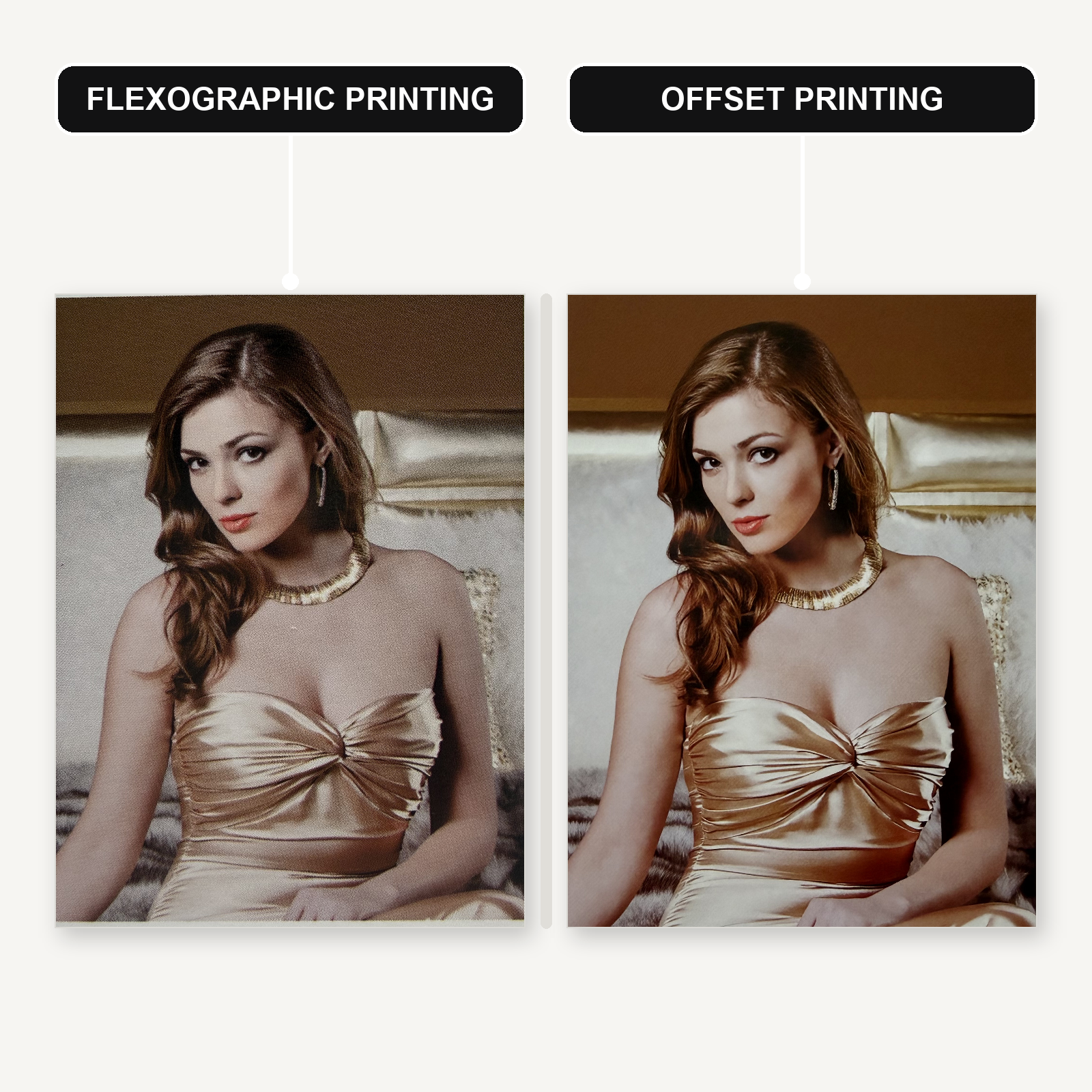
Flexographic Printing vs. Offset Printing
Flexographic and offset printing are both important packaging processes, but they are optimized for different materials and production environments. If you need to compare packaging printing methods beyond flexo and offset, our main guide also covers digital and screen printing and explains how substrate, quantity, artwork, and SKU count affect the decision.
| Factor | Flexographic Printing | Offset Printing |
|---|---|---|
| Printing Principle | Direct relief printing | Indirect lithographic printing |
| Plate | Flexible relief plate | Offset plate |
| Intermediate Blanket | No | Yes |
| Common Format | Often roll-fed; also direct corrugated applications | Commonly sheet-fed for paper packaging |
| Corrugated Direct Print | Major application | Usually not the primary direct-print route |
| Flexible Film | Major application | Limited compared with flexo |
| Folding Cartons | Possible | Major application |
| Spot Colors | Excellent | Excellent |
| CMYK | Yes | Yes |
| Fine Photographic Detail | High quality possible with suitable flexo setup | Traditionally a major strength |
| Long Production Runs | Excellent | Excellent |
| Substrate Versatility | Particularly strong across packaging webs/materials | Particularly strong for suitable paper/paperboard sheets |
For a premium folding carton with extremely detailed graphics on coated paperboard, offset may be a natural choice.
For roll-fed labels, paper bags, corrugated board or flexible packaging produced continuously at scale, flexography may be more appropriate.
The choice should be based on the complete packaging structure rather than print quality alone.
Flexographic Printing vs. Digital Printing
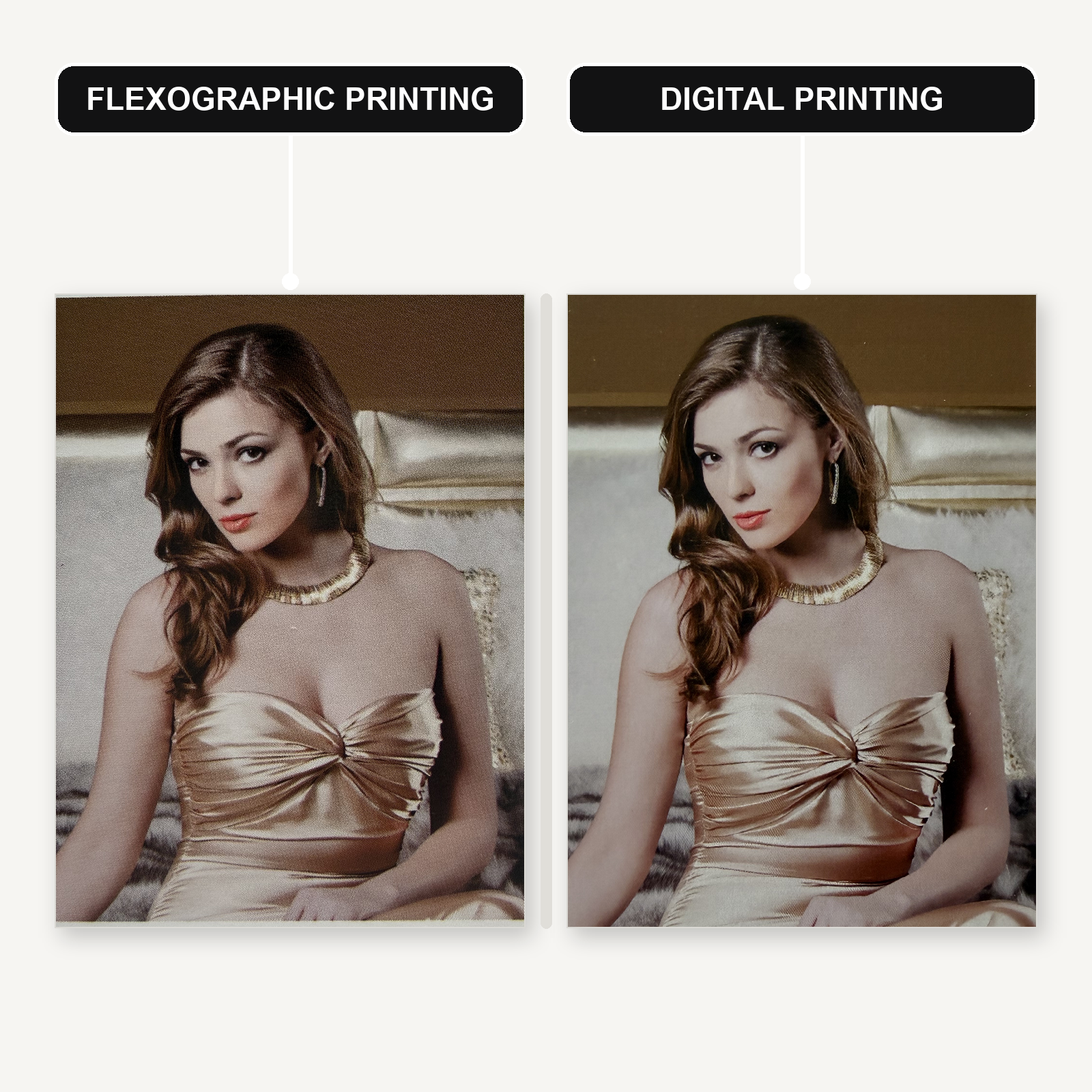
Digital printing approaches production from almost the opposite direction.
Digital eliminates conventional printing plates and prioritizes flexibility.
Flexography requires plates but becomes highly efficient once a repeat production run is established.
| Factor | Flexographic Printing | Digital Printing |
|---|---|---|
| Printing Plates | Required | Normally not required |
| Setup Cost | Higher | Lower |
| Short Runs | Less advantageous in many cases | Strong |
| Large Repeat Runs | Strong | Often less economical |
| Variable Data | Poor fit | Excellent |
| Artwork Changes | Plate changes may be required | Easy |
| Multiple Small SKUs | Setup can increase | Strong advantage |
| Roll-Fed Packaging | Major application | Equipment-dependent |
| Spot Colors | Strong | Equipment-dependent |
| Production Speed at Scale | High | Equipment-dependent |
For 100 packages with frequently changing artwork, digital may be much more practical.
For a stable packaging design produced repeatedly in large quantities, flexographic economics can become much more attractive.
There is no universal crossover quantity.
Flexographic Printing vs. Gravure Printing
Flexo and gravure are frequently compared because both are important for high-volume flexible packaging.
Their image-transfer systems are fundamentally different.
Flexography uses raised image areas on flexible plates.
Gravure uses recessed cells engraved into a printing cylinder.
Both can produce high-quality packaging at volume, but tooling economics, press configuration, artwork, substrate and production quantity can influence which is more suitable.
In general, flexographic plates are less costly to prepare than engraved gravure cylinders, while gravure has historically been particularly strong for very long runs and highly consistent image reproduction. Modern flexography has increasingly competed with gravure as plate, anilox and press technologies have improved.
Flexographic Printing vs. Screen Printing
Flexographic printing and screen printing can both produce strong spot colors, but their production logic is very different.
Flexography is optimized for continuous, repeatable production.
Screen printing is particularly useful when heavier ink deposits, high opacity or specific tactile printed effects are required.
For packaging buyers, this means the decision is not simply:
Which process produces stronger color?
It is:
What ink deposit, material, quantity, artwork and visual effect does the project require?
Our metallic-silver tissue-paper case demonstrates exactly this distinction: the screen-printed silver was brighter than offset, yet the final required metallic character was achieved through a different substrate and flexographic process.
Advantages of Flexographic Printing
Flexographic printing becomes particularly attractive when several of the following conditions occur together.
High Production Efficiency
Continuous web-fed production can support high output once the press is set up.
Broad Substrate Range
Flexo can be adapted to many paper, corrugated, label and film applications.
Strong Spot-Color Capability
Solid brand colors can be reproduced using dedicated inks.
Suitable for Corrugated Packaging
Relatively light printing pressure and flexible plates make flexography particularly useful for direct corrugated printing.
Inline Converting Potential
Depending on the equipment, printing can be integrated with other operations such as coating, laminating, slitting, die cutting or rewinding.
This can reduce handling between production stages.
Limitations of Flexographic Printing
Flexography also has limitations that should be considered before choosing it.
Plates Are Required
Unlike digital printing, new artwork can require new plates.
This creates fixed setup costs.
Multiple SKUs Increase Setup Complexity
If every SKU changes printed graphics, additional plates and press changeovers may be required.
Substrate Variation Affects Print Quality
Corrugated, kraft, coated paper and plastic film behave differently.
Fine Graphics Require More Process Control
High-quality process printing depends on the relationship between artwork, plate, anilox, ink and substrate.
Film Printing Requires Adhesion Control
Non-porous substrates can require surface treatment and appropriate ink chemistry.
These are not reasons to avoid flexography—they are reasons to select it based on the actual packaging specification.
What Determines the Cost of Flexographic Printing?
| Cost Factor | Why It Matters |
|---|---|
| Quantity | Higher quantities distribute setup costs across more units |
| Number of Colors | Each independent color may require a plate and printing station |
| Plate Making | Creates a fixed initial tooling cost |
| Number of SKUs | Different artwork may require additional plates |
| Substrate | Paper, corrugated and films have different costs and processing requirements |
| Ink System | Water-based, solvent or UV systems have different production requirements |
| Ink Coverage | Heavy solids can influence ink consumption and anilox selection |
| Roll/Web Dimensions | Affect press configuration and material utilization |
| Registration Requirements | Complex multicolor artwork requires tighter process control |
| Finishing | Lamination, coating, slitting and converting add operations |
| Repeat Orders | Reusable plates may reduce some setup costs if they remain suitable |
This is why asking:
“How much does flexographic printing cost per piece?”
without specifying the package is difficult to answer accurately.
Common Flexographic Printing Problems and How to Reduce Them
| Problem | Possible Cause | Production Consideration |
|---|---|---|
| Color Appears Weak | Insufficient ink transfer / substrate absorption | Review ink, anilox and substrate |
| Fine Details Fill In | Excessive ink film or unsuitable plate/anilox combination | Optimize plate and anilox specification |
| Pinholes or Uneven Solids | Surface or ink-transfer issues | Evaluate substrate, ink and anilox |
| Color Differs Between Materials | Different substrate color/absorbency | Proof on actual production material |
| Registration Variation | Web tension, plate mounting or press control | Optimize registration and web control |
| Ink Adhesion Is Poor on Film | Low surface energy or unsuitable ink | Confirm treatment and ink compatibility |
| Ink Dries Too Slowly | Ink/substrate/drying mismatch | Adjust drying system and ink formulation |
| Corrugated Graphics Appear Uneven | Board surface variation | Match ink film and plate setup to board |
| Small Text Loses Clarity | Artwork/process limitations | Adjust artwork and production specification |
Many flexographic problems are not caused by one component alone.
They are interactions between:
plate + anilox + ink + substrate + pressure + drying + artwork.
That is one of the most useful principles for diagnosing flexographic print quality.
Can Flexographic Printing Be Combined With Packaging Finishes?
Yes, although the available sequence depends heavily on the packaging format.
Paper and paperboard packaging may be combined with processes such as lamination, varnishing, coatings and structural converting.
Flexible packaging may instead involve reverse printing, adhesive lamination, coatings, slitting and pouch converting.
Corrugated packaging may proceed to die cutting, creasing, slotting, folding and gluing.
Decorative processes such as foil stamping or embossing may also be possible on suitable paper packaging, but the complete production construction should be evaluated rather than assuming every finish works with every flexographic substrate.
For a broader overview of decorative surface processes, see our Packaging Finishes guide.
How Should Artwork Be Prepared for Flexographic Printing?
Flexographic artwork should be prepared for the actual production process rather than simply reusing artwork designed for another printing method without review.
Important considerations include:
Color Separation
Clearly identify CMYK and spot-color elements.
Minimum Detail
Very fine lines, reversed text and small elements should be checked against the capabilities of the plate, substrate and press.
Trapping
Adjacent colors may require appropriate trapping to accommodate practical registration tolerances.
There is no universal trapping value suitable for every flexographic job.
Dot Gain
Flexographic printing can produce tonal changes as dots transfer through the plate and substrate.
Prepress compensation should therefore be based on the actual press condition rather than generic assumptions.
Substrate Color
Artwork prepared for white coated paper may need adjustment when printed on brown kraft or another colored material.
Dielines
Cutting, creasing, perforations and other structural information should remain clearly separated from printing artwork.
For structural preparation, see our Die Cutting for Packaging guide.
What to Specify When Requesting a Flexographic Printing Quote
| Information | Example |
|---|---|
| Packaging Type | Printed paper bag |
| Finished Size | 250 × 100 × 320 mm |
| Quantity | 50,000 pcs |
| Substrate | Kraft paper |
| Printing | Flexographic printing |
| Colors | 2 Pantone spot colors |
| Artwork Versions | 1 SKU |
| Printing Sides | One side / two sides |
| Surface Requirement | Uncoated |
| Special Requirements | Color target / rub resistance |
| Artwork | Production-ready file supplied |
| Delivery | Country / postal code |
For flexible packaging, additional information may include film structure, web width, print orientation, surface/reverse printing, lamination construction and end-use requirements.
For corrugated packaging, board construction and flute type are also important.
When Should You Choose Flexographic Printing?
Flexographic printing is particularly worth considering when:
- the package uses corrugated board;
- the project uses roll-fed paper or film;
- the quantity is sufficiently large to justify plate setup;
- the same artwork will be repeated;
- strong spot colors are required;
- continuous production efficiency is important;
- the substrate is better suited to flexo than sheet-fed offset;
- printing and converting can be integrated efficiently.
Digital printing may be more appropriate when quantities are very small or artwork changes frequently.
Offset printing may be more appropriate for certain premium sheet-fed folding cartons.
Gravure may become relevant for certain very large flexible-packaging runs.
The best printing method therefore depends on the complete production system.
Frequently Asked Questions About Flexographic Printing
What types of packaging are commonly flexographically printed?
Flexography is commonly used for corrugated boxes, paper bags, labels, wrappers, flexible packaging, tissue and wrapping papers, and other paper or film-based packaging. The exact application depends on the press and substrate.
Is flexographic printing lower quality than offset printing?
Not necessarily. Modern flexography can produce high-quality process graphics, photographs and fine text. Offset remains particularly strong for premium sheet-fed paperboard printing, while flexography has advantages on corrugated, films and continuous web-fed packaging. Plate technology, anilox specification, substrate and press control all influence flexographic quality. Learn more about flexographic printing.
Does flexographic printing require printing plates?
Yes. Flexography uses flexible relief plates, commonly photopolymer plates. Different printed colors normally require separate plates. This creates an initial setup cost, but the cost can be distributed across larger repeat runs.
Can flexographic printing use Pantone colors?
Yes. Flexography can print dedicated spot colors as well as CMYK process colors. Pantone references are commonly used as color targets for brand colors, although the final appearance is still affected by substrate and ink conditions.
Can flexographic printing reproduce photographs?
Yes. Modern flexographic systems can reproduce CMYK photographic artwork. The achievable detail depends on plate technology, anilox selection, substrate smoothness, registration and press capability.
Is flexographic printing suitable for kraft paper?
Yes. Kraft paper is a common flexographic substrate. Because kraft is absorbent and has its own brown base color, the final print can differ from the same artwork printed on coated white paper. Artwork and ink should therefore be evaluated on the actual substrate.
Can flexographic printing be used on plastic film?
Yes, with suitable equipment, inks and surface preparation. Flexography is widely used on films such as BOPP, PET and PE. Because these substrates are non-porous, surface energy, wetting, adhesion and drying need to be controlled. Learn more from the Flexographic Technical Association.
Are flexographic inks always water-based?
No. Flexographic printing can use water-based, solvent-based or UV-curable ink systems depending on the press, substrate and packaging application. Water-based inks are particularly common in paper and corrugated applications, while flexible packaging can use different systems according to performance requirements. Read about flexographic ink considerations.
Is flexographic printing suitable for small quantities?
It can be technically possible, but plate making and press setup create fixed costs. For very small quantities or many low-volume SKUs, digital printing may be more economical. There is no universal quantity threshold.
Can flexographic printing plates be reused?
They can often be reused for repeat production if the artwork remains unchanged, the plates are properly stored and they remain in suitable condition. The practical reuse life depends on the plate material, print conditions and supplier's production workflow.
What is the difference between flexographic and gravure printing?
Flexography prints from raised images on flexible plates, while gravure transfers ink from recessed cells engraved into cylinders. Both are important for high-volume packaging, especially flexible packaging, but tooling costs, run length, graphics and production requirements differ.
Why does the same flexographic color look different on different materials?
The substrate influences how ink is absorbed, reflected and perceived. A Pantone or CMYK color printed on coated white paper, uncoated kraft and corrugated liner can therefore look different even when the artwork is unchanged. For critical colors, approve the result on the intended production material.
Choosing Flexographic Printing for Your Packaging Project
Flexographic printing is valuable because it combines continuous production efficiency, broad substrate compatibility and flexible ink/color options.
But its versatility also means that simply specifying “flexo printing” is not enough.
A successful project depends on matching:
substrate + artwork + plate + anilox + ink + quantity + converting requirements.
For one project, that may mean two-color water-based flexographic printing on kraft corrugated board. For another, it may mean CMYK printing on a coated paper. In our metallic-silver tissue-paper project, it meant pairing an unconventional 80 gsm MG paper with flexographic silver printing to achieve the required visual result.
The correct process is therefore the one that produces the required packaging result reliably and economically—not simply the printing technology with the highest theoretical capability.
Vigor Packaging can evaluate the printing method together with your material, artwork, quantity, color requirements and finishing specifications.
Contact us to discuss your custom packaging project.