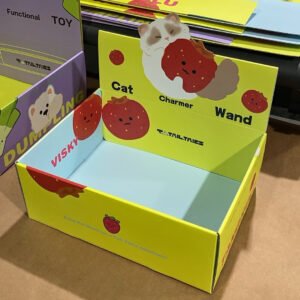
Offset printing is one of the most established printing methods for paper packaging, particularly when a project requires detailed graphics, consistent color reproduction, Pantone spot colors, or efficient production at medium to large quantities.
For packaging buyers, however, choosing offset printing involves more than print quality alone. Paper surface, ink coverage, substrate color, production quantity, white ink, finishing processes, and the final packaging structure can all influence the result.
A well-planned offset printing project therefore starts by matching the artwork, substrate, printing specification, quantity, and finishing requirements rather than selecting the printing method in isolation.
Quick Answer: Offset printing is an indirect printing process in which ink is transferred from a printing plate to a rubber blanket and then onto paper or paperboard. It is widely used for packaging that requires detailed CMYK graphics, Pantone spot colors, consistent repeat production, and cost-efficient medium- to high-volume printing.
Because offset printing requires plates and press setup, its initial setup cost is generally higher than digital printing. However, these fixed costs are distributed across the production quantity, making offset increasingly economical as the run becomes larger.
Offset Printing at a Glance
| Factor | Offset Printing |
|---|---|
| Printing Principle | Plate → rubber blanket → substrate |
| Common Color Systems | CMYK, Pantone / spot colors |
| Printing Plates | Required |
| Best Suited For | Medium and large production runs |
| Image Reproduction | Excellent for fine text, graphics, gradients and photography |
| Color Consistency | Strong across repeat production when properly controlled |
| Brand Colors | Dedicated Pantone spot colors can be used |
| Common Substrates | Coated paper, paperboard, kraft and selected specialty papers |
| Metallic Substrates | Selected silver and gold card can be offset printed |
| Variable Data | Not a practical strength; digital printing is generally better |
| Initial Setup Cost | Higher than digital printing |
| Unit Economics | Generally improve as quantity increases |
| Compatible Finishing | Lamination, varnishing, UV coating, foil stamping, embossing, debossing and die cutting |
What Is Offset Printing?
Offset printing, also known as offset lithography, is an indirect printing process.
Unlike direct printing methods, the image does not transfer directly from the printing plate to the paper.
Instead, it follows three stages:
Printing plate → rubber blanket → printing substrate
The word “offset” refers to this intermediate transfer.
For standard four-color printing, the artwork is separated into:
- Cyan (C)
- Magenta (M)
- Yellow (Y)
- Black (K)
Each process color uses its own printing plate.
As these four inks are printed in controlled combinations of halftone dots, they visually reproduce photographs, gradients, illustrations, and a wide range of colors.
Additional plates can be used for Pantone spot colors, white ink, or other independently printed colors when required.
Offset printing is only one of several processes used for custom packaging. The right choice depends on the substrate, order quantity, artwork complexity, color requirements, and number of designs. For a broader comparison, see our guide to packaging printing methods, including offset, digital, flexographic, and screen printing.
How Does Offset Printing Work for Packaging?
Packaging usually goes through several stages between receiving the artwork and converting the printed sheet into a finished box.
1. Artwork and Prepress Preparation
Before plate making, the artwork should be checked for:
- dieline dimensions
- bleed and safe areas
- image resolution
- CMYK color settings
- Pantone specifications
- overprint settings
- trapping
- fonts
- special-color separations
- finishing layers
The substrate should ideally be confirmed at this stage because the same ink specification can appear different on different papers.
2. Color Separation and Plate Making
The artwork is separated into individual printing colors.
Standard CMYK printing normally requires four plates.
If the design contains a dedicated Pantone color, white ink, or another independently printed color, additional plates are normally required.
For example:
CMYK + 1 Pantone = 5 printing colors
This is one reason why the number of colors affects offset printing setup and cost.
3. Press Setup and Makeready
The plates are mounted on the press, and the printer adjusts registration, ink density, color balance, and other production parameters.
Sheets consumed while establishing stable production conditions are part of the makeready process.
This fixed preparation requirement explains why offset printing economics do not scale directly with quantity.
Printing 500 sheets does not simply cost half as much as printing 1,000 sheets because plate making and press preparation are still required.
4. Printing
Ink transfers from the plate to the rubber blanket and then onto the paper or paperboard.
Once the press reaches stable production conditions, offset printing can efficiently reproduce the same artwork across a large number of sheets.
5. Post-Press Finishing and Converting
After printing and appropriate drying or curing, the sheets can proceed to processes such as packaging lamination, packaging varnishing, UV coating, foil stamping, embossing, or other packaging finishes.
The printed sheets are then converted into the required packaging structure through processes such as die cutting, creasing, folding, and gluing.
CMYK vs Pantone Colors in Offset Printing
One important advantage of offset printing for branded packaging is the ability to use both process and dedicated spot colors.
CMYK Process Printing
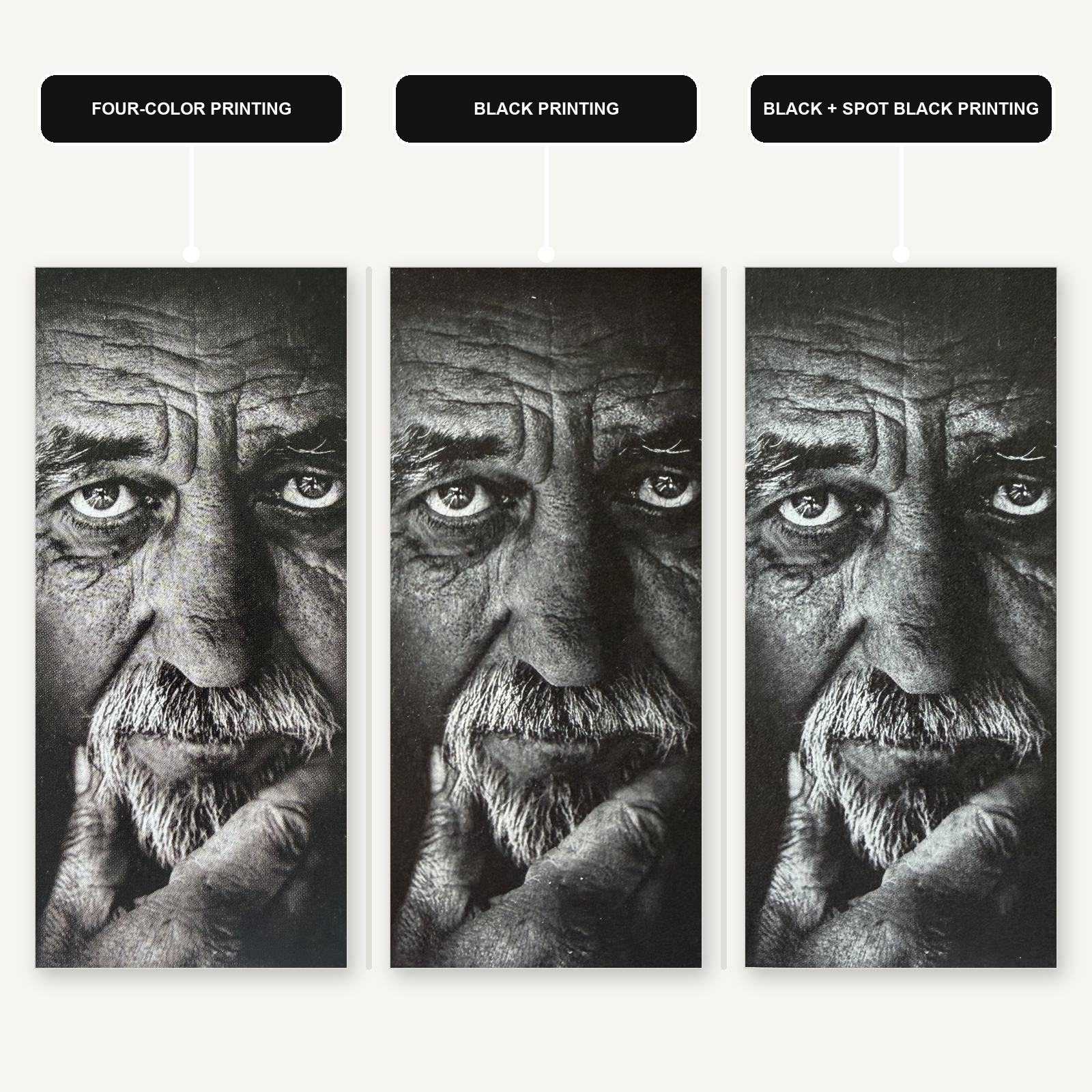
CMYK combines four process inks to reproduce full-color artwork.
It is particularly suitable for:
- photographs
- illustrations
- gradients
- multicolor graphics
- complex artwork containing many colors
However, CMYK creates colors by combining process inks. Some brand colors cannot be reproduced exactly within the CMYK color gamut.
Pantone and Spot Color Printing
When a specific brand color is particularly important, it can be prepared as a dedicated spot ink rather than simulated entirely through CMYK.
This is common for logos, corporate colors, and packaging systems where color consistency is important.
| Requirement | CMYK | Pantone / Spot Color |
|---|---|---|
| Photography | Excellent | Not normally used alone |
| Complex Multicolor Artwork | Excellent | Less efficient |
| Gradients | Excellent | Application-dependent |
| Brand-Color Control | Good within CMYK gamut | Generally better for specified spot colors |
| Standard Ink Count | Usually 4 | Additional ink for each spot color |
| Additional Printing Plate | No beyond CMYK set | Yes |
| Typical Use | Images and complex graphics | Logos and important brand colors |
Why Printed Packaging Does Not Look Exactly Like Your Screen
A monitor and a printed package produce color in fundamentally different ways.
Screens use RGB light, while printed packaging uses physical inks that reflect ambient light.
The printing substrate introduces another variable.
The same ink can appear different on:
- bright white coated paper
- uncoated paper
- brown kraft
- textured specialty paper
- silver metallic card
Surface smoothness, absorbency, paper color, ink density, coating, and lighting conditions can all influence the perceived result.
For color-critical packaging, a screen PDF should therefore not be treated as the only color standard. Physical samples, press proofs, Pantone references, or agreed production standards provide more useful references.

What Materials Can Be Offset Printed?
Offset printing is particularly well suited to flat paper and paperboard materials used in packaging.
Coated Paper and Paperboard
Smooth coated stocks provide a relatively controlled printing surface and are widely used for:
- folding cartons
- cosmetic boxes
- food packaging
- printed sleeves
- rigid box wrapping paper
- retail packaging
Fine graphics, small text, photographs, and gradients can generally be reproduced effectively.
Uncoated and Specialty Paper
Many uncoated and specialty papers can also be offset printed.
However, a more absorbent or heavily textured surface can change ink density, dot reproduction, and perceived sharpness compared with smooth coated paper.
For unusual specialty papers, physical testing becomes increasingly valuable.
Kraft Paper
Suitable kraft papers can be offset printed, but kraft is not a neutral white printing surface.
The brown substrate influences transparent process inks, often producing a more natural or muted appearance.
When bright colors or white graphics are required, white ink or another production strategy may be necessary.
This is also a good example of why the printing method cannot be evaluated separately from the substrate.
A Real Production Example: When Offset Was Not the Best Final Solution
A previous Vigor Packaging project provides a useful example.
The customer wanted relatively thick, less transparent tissue paper and specified 80 gsm white kraft paper with a metallic silver pattern.
Because white kraft absorbs ink and can influence metallic appearance, we evaluated both offset silver printing and screen-printed silver on the 80 gsm white kraft during trial production.
The offset-printed silver appeared relatively dark and subdued.
Screen printing produced a brighter and glossier result, but the increased brightness was primarily reflected light rather than the distinct metallic character the customer wanted.
Instead of simply accepting the closest result, we changed another variable: the substrate.
We ultimately tested 80 gsm machine-glazed (MG) paper with flexographic silver printing, which achieved the desired metallic appearance while retaining the customer’s requirement for thicker, less transparent paper.
You can see the complete production analysis in our metallic silver printing on tissue paper case study.
The important lesson is not that flexographic printing is “better” than offset printing.
It is that:
Printing process + substrate + ink + required visual effect must be evaluated as one production system.
Offset printing may be an excellent process technically, but another process can still be more appropriate when the material and desired visual effect change.
Offset Printing on Gold and Silver Metallic Paper
Metallic card provides another good example of the relationship between printing and substrate.
Gold and silver card do not behave like ordinary white paperboard because their reflective surface becomes part of the final artwork.
In packaging design, this means the printer can control where the metallic substrate remains visible and where it is reduced or covered.
Why Is White Ink Used on Silver or Gold Card?
Standard process inks are not completely opaque.
When CMYK is printed directly over reflective silver card, part of the metallic character can remain visible through the printed colors.
This can be used deliberately.
For example:
Silver substrate + CMYK → colored metallic appearance
If a white ink layer is placed underneath selected CMYK areas, the metallic influence can be reduced:
Silver substrate + white ink + CMYK → more conventional opaque color appearance
The same artwork can therefore contain both conventional-looking printed areas and metallic-looking areas simply by controlling the white underprint.
The Metallic Effect May Come From the Material, Not the Ink
Metallic papers can contain very different optical structures.
Our physical printing samples include relatively plain metallic surfaces as well as linear light effects, textured metallic surfaces, holographic structures, and other optical patterns.
This creates an important design distinction:
Not every visual effect visible on metallic packaging is created by the printing ink.
Sometimes the ink provides the image while the substrate provides the optical effect.
For this reason, metallic material selection and artwork development should ideally be considered together.
Registration Requires More Attention
When white ink, CMYK, and selective effects need to overlap precisely, small registration differences can become more visible.
Fine outlines, tiny reversed text, and extremely narrow white-underprint areas therefore require careful prepress planning.
Physical sampling is particularly useful for complex metallic-card packaging.
Offset Printing vs Digital Printing
Neither process is universally better.
Their strengths are different.
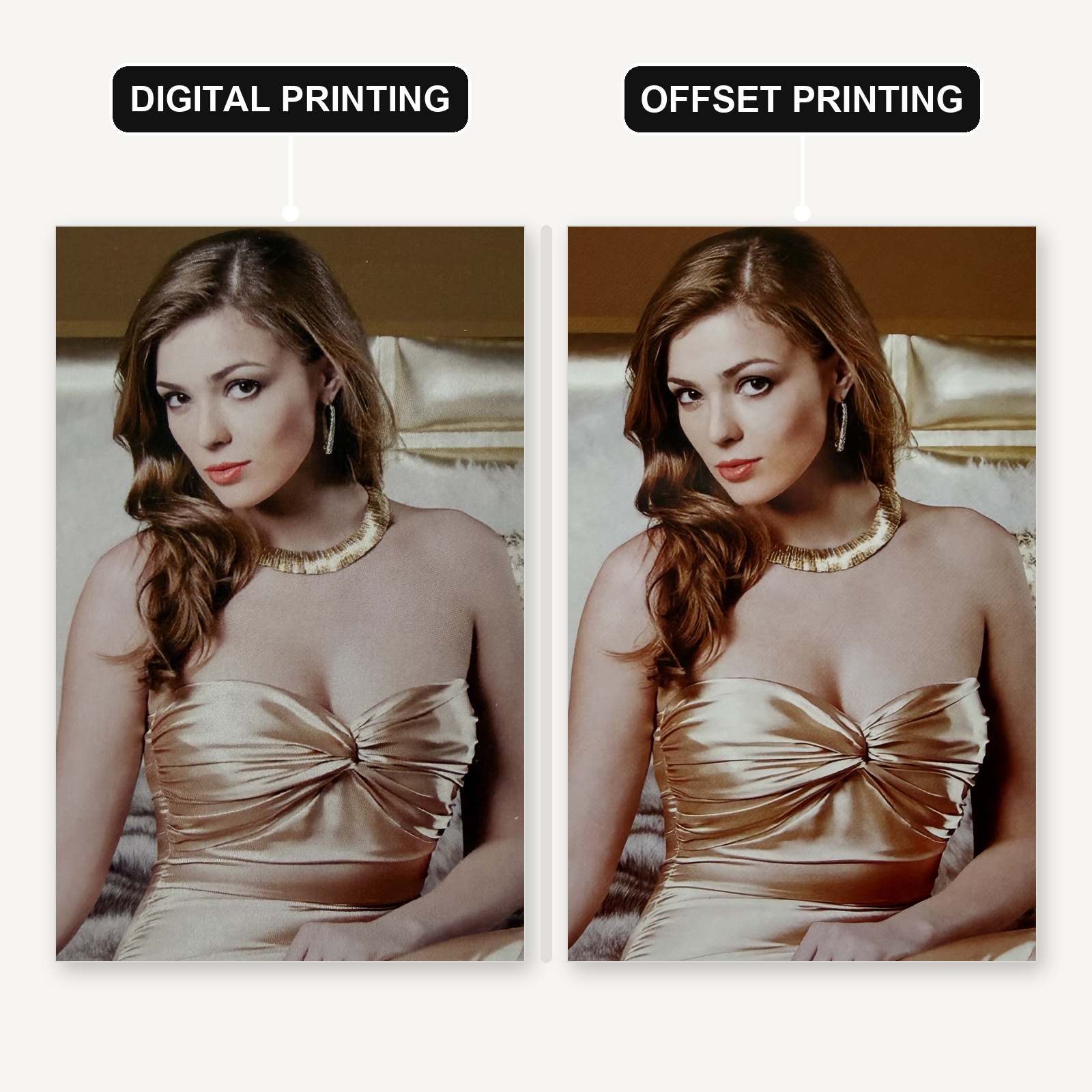
Digital printing normally eliminates conventional plate making, making it particularly attractive for short runs, frequently changing artwork, prototypes, or variable information.
Offset requires more setup but becomes increasingly efficient when the same artwork is produced repeatedly at larger quantities.
| Factor | Offset Printing | Digital Printing |
|---|---|---|
| Printing Plates | Required | Normally not required |
| Initial Setup | Higher | Lower |
| Short Runs | Usually less economical | Often advantageous |
| Medium/Large Runs | Often highly economical | Depends on equipment and job |
| Unit Cost as Quantity Increases | Usually decreases significantly | Typically changes less dramatically |
| CMYK | Yes | Yes |
| Dedicated Pantone Inks | Strong capability | Equipment-dependent; often simulated |
| Long-Run Consistency | Excellent when controlled | Very good with suitable equipment |
| Variable Data | Poor fit | Excellent |
| Artwork Changes Between Units | Impractical | Easy |
| Packaging Applications | Excellent | Excellent for suitable applications |
At What Quantity Does Offset Become Cheaper Than Digital?
There is no universal crossover quantity.
The economics depend on:
- packaging dimensions
- printing sheet size
- number of colors
- number of SKUs
- substrate
- press configuration
- finishing processes
- material utilization
- setup requirements
For example, 5,000 identical cartons and 5,000 cartons divided among 20 different designs can have very different production economics.
Rather than applying a fixed rule such as “offset above X pieces,” the better approach is to compare the complete specifications.
Offset Printing vs Screen Printing
Offset and screen printing transfer ink in very different ways.
Offset is particularly strong for detailed graphics, photography, fine text, and efficient full-color sheet printing.
Screen printing pushes ink through a mesh stencil and can create a heavier ink deposit, making it useful for bold opaque colors and certain specialty substrates.
| Factor | Offset Printing | Screen Printing |
|---|---|---|
| Full-Color Photographs | Excellent | Less efficient |
| Fine Details | Excellent | Good, depending on artwork and mesh |
| Solid Spot Colors | Excellent | Excellent |
| Ink Deposit | Relatively thin | Can be substantially heavier |
| Tactile Ink Character | Limited | Stronger potential |
| Plate/Screen Requirement | Plate per color | Screen per color |
| Large Sheet Runs | Excellent | Application-dependent |
| Specialty Surfaces | Substrate-dependent | Often more adaptable |
The 80 gsm metallic-silver tissue-paper case above illustrates why this distinction matters: a heavier ink deposit can change brightness and opacity, but it does not automatically guarantee the exact metallic character required.
Offset Printing vs Foil Stamping
Offset printing and foil stamping are sometimes compared because both can contribute to premium packaging, but they perform fundamentally different functions.
Offset creates printed graphics and colors.
Foil stamping transfers a foil layer onto selected areas of the packaging.
| Offset Printing | Foil Stamping |
|---|---|
| Creates printed graphics | Creates selected foil effects |
| Uses printing inks | Uses transferred foil |
| Suitable for CMYK and spot colors | Suitable for metallic, holographic and other foil effects |
| Can reproduce detailed full-color images | Typically used for selected decorative areas |
| Printing process | Finishing process |
They are frequently combined.
For example:
CMYK offset → matte lamination → gold foil logo → embossing → die cutting
Each process performs a different function within the finished package.
Metallic Paper Printing vs Foil Stamping
If the design requires a large metallic background or metallic reflection throughout illustrations and colors, printing directly onto gold or silver card can be effective.
If only a logo, border, text, or selected decorative element needs a strong metallic finish, foil stamping may be more appropriate.
The simplest distinction is:
Metallic paper: the metallic effect begins with the substrate.
Foil stamping: the metallic effect is selectively added to the substrate.
Premium packaging can also combine both.
Can Offset Printing Be Combined With Packaging Finishes?
Yes.
Offset printing is commonly followed by surface and decorative processes such as lamination, varnishing, UV coating, foil stamping, embossing, debossing, and flocking.
You can explore these options in our complete guide to packaging finishes.
The production sequence matters. Ink, substrate, coatings, films, adhesives, and subsequent finishing processes must be compatible with one another.
Common Offset Printing Problems and How to Avoid Them
| Problem | Possible Cause | Production Consideration |
|---|---|---|
| Printed Color Differs From Screen | RGB/CMYK difference, substrate influence | Use CMYK artwork and physical/Pantone references |
| Brand Color Is Inconsistent | CMYK simulation or insufficient color control | Consider a dedicated Pantone spot color |
| Colors Look Dull on Kraft | Brown substrate affects transparent inks | Consider white ink or artwork adjustment |
| Metallic Paper Changes Colors | Reflective substrate shows through ink | Use controlled white underprinting where required |
| Fine White-Underprint Edges Become Visible | Registration tolerance | Avoid unnecessarily critical narrow overlaps and plan trapping |
| Ink Adhesion Is Poor | Substrate/coating incompatibility | Test specialty substrates before production |
| Fold Areas Crack | Board, grain, ink/coating and creasing conditions | Coordinate printing with structural converting |
| Reorder Looks Slightly Different | Paper/ink/press/standard differences | Keep approved physical color references and specifications |
| Fine Artwork Becomes Unclear | Insufficient resolution or unsuitable artwork | Supply appropriate vector/high-resolution files |
How Should Artwork Be Prepared for Offset Printing?
Good print quality begins with prepress.
| Item | Recommendation |
|---|---|
| Artwork | Production-ready PDF, AI or other suitable vector format |
| Color Mode | CMYK for process artwork |
| Brand Colors | Specify Pantone references where required |
| Images | Adequate resolution at final reproduction size |
| Bleed | Include according to the approved dieline |
| Fonts | Outline or package as required |
| Dieline | Separate cut, crease and other structural lines |
| Foil / UV / Embossing | Define as separate layers or spot colors |
| Metallic-Paper White Ink | Clearly define white-underprint areas |
| Black Text | Check black construction and overprint settings |
| Final Dimensions | Match the approved packaging dieline |
Exact artwork requirements should always be confirmed with the manufacturer because prepress workflows and equipment differ.
What Determines the Cost of Offset Printing?
Offset printing cost is influenced by more than quantity.
| Cost Factor | Why It Matters |
|---|---|
| Quantity | Fixed setup costs are distributed across more units |
| Number of Colors | Additional colors can require additional plates and setup |
| Sheet Size | Influences press selection and material utilization |
| Packaging Dimensions | Determine how many pieces fit on each printing sheet |
| Substrate | Specialty materials can increase material and setup requirements |
| Number of SKUs | Different artwork may require different plates |
| White Ink | Adds another printing color/operation where required |
| Pantone Colors | Require separate ink and plate preparation |
| Finishing | Lamination, UV, foil, embossing and other processes add cost |
| Die Cutting | Requires structural converting and potentially tooling |
| Color Requirements | Tight tolerances may require additional proofing and control |
How to Specify Offset Printing When Requesting a Quote
Providing complete information makes it easier for a packaging manufacturer to determine the correct printing and converting route.
| Information | Example |
|---|---|
| Packaging Type | Folding carton |
| Finished Size | 120 × 80 × 40 mm |
| Quantity | 5,000 pcs |
| Material | 350 gsm coated paperboard |
| Printing | CMYK offset |
| Spot Color | 1 Pantone color |
| Surface Finish | Matte lamination |
| Decorative Finish | Gold foil logo |
| Structure | Custom die-cut carton |
| Number of SKUs | 2 |
| Artwork | Production-ready dieline supplied |
| Delivery | Country / ZIP code |
If the substrate or printing method has not yet been determined, providing the intended appearance and physical packaging requirements can be more useful than specifying a process prematurely.
When Should You Choose Offset Printing?
Offset printing is particularly suitable when:
- the packaging will be produced in medium or large quantities;
- the same artwork will be reproduced repeatedly;
- detailed graphics or photography are required;
- Pantone spot colors are important;
- color consistency across the run matters;
- the selected paper or paperboard is suitable for offset;
- multiple post-print finishing processes will be applied.
Digital printing may be more practical for very small quantities, frequently changing artwork, or variable information.
Screen, flexographic, gravure, and other printing processes may also be preferable for particular substrates, quantities, structures, or visual effects.
The correct question is therefore not simply:
“Is offset printing good?”
but rather:
“Is offset printing the right process for this packaging material, artwork, quantity, and required result?”
Frequently Asked Questions About Offset Printing
Is offset printing better quality than digital printing?
Not automatically. Modern digital printing can produce excellent packaging. Offset is particularly strong for consistent medium- and large-volume production, detailed graphics, and dedicated spot colors. The better process depends on the artwork, substrate, quantity, and color requirements.
What is the minimum order quantity for offset printing?
Offset printing has no universal technical MOQ. However, plate making, press setup, and makeready create fixed costs, so very small quantities may not be economical. Practical MOQ depends on the packaging dimensions, material, colors, press configuration, and supplier.
At what quantity does offset printing become cheaper than digital?
There is no fixed crossover quantity. Sheet utilization, number of colors, substrate, SKU count, setup requirements, and finishing all affect the calculation. A quotation based on the complete packaging specification is more reliable than using a universal quantity threshold.
Does every color require a separate offset printing plate?
Generally, each independently printed color requires its own plate. Standard CMYK therefore normally uses four plates. Pantone spot colors, white ink, or other separately printed inks normally require additional plates.
Can offset printing match Pantone colors?
Offset printing can use dedicated Pantone or other spot-color inks, providing strong control for important brand colors. The final appearance can still be influenced by the paper, coating, ink density, and lighting, so physical approval remains important for color-critical packaging.
Can offset printing be used on kraft paper?
Yes. Suitable kraft papers can be offset printed. However, the brown substrate influences transparent inks, so colors may appear more muted than on white coated paper. White underprinting or artwork adjustment may be needed for brighter colors.
Can offset printing be used on gold and silver card?
Yes, selected metallic gold and silver papers can be offset printed. CMYK can interact with the reflective substrate to create metallic colors, while white underprinting can reduce the metallic influence in selected areas. Ink adhesion and material compatibility should be confirmed before production.
Why does offset-printed packaging look different from the PDF on my screen?
Screens use RGB light, while printing uses physical inks reflecting light from paper or paperboard. Substrate color, surface texture, ink density, coatings, and viewing conditions all influence the result. A monitor is therefore not an exact physical print standard.
If I change one SKU, do I need new offset printing plates?
If the printed content on a plate changes, the affected plate normally needs to be changed. Projects containing many low-volume SKUs can therefore have different economics from a single-design production run.
Can offset printing plates be reused for repeat orders?
They may sometimes be reused if the artwork has not changed, the plates have been retained and remain suitable, and the manufacturer's workflow allows reuse. Plate-storage and reuse policies vary between suppliers.
Can offset printing produce metallic silver or gold?
Metallic inks can be offset printed, but the result is not identical to foil stamping or printing on a metallic substrate. Ink deposit, substrate absorbency, surface smoothness, and lighting influence the metallic appearance. For strong metallic effects, physical sampling is recommended.
Should I use CMYK or Pantone for my packaging logo?
CMYK may be sufficient when the logo is integrated into full-color artwork and the required color falls comfortably within the CMYK gamut. When a specific brand color requires tighter control, a dedicated Pantone spot color may be preferable.
Developing Custom Printed Packaging?
Offset printing is only one part of the packaging production system.
Material selection, artwork, printing method, color requirements, surface finishing, structural converting, quantity, and final application should be evaluated together.
Vigor Packaging can review these factors before production and recommend a suitable combination of printing, materials, and finishing processes for your project.
Contact us to discuss your custom packaging requirements.